

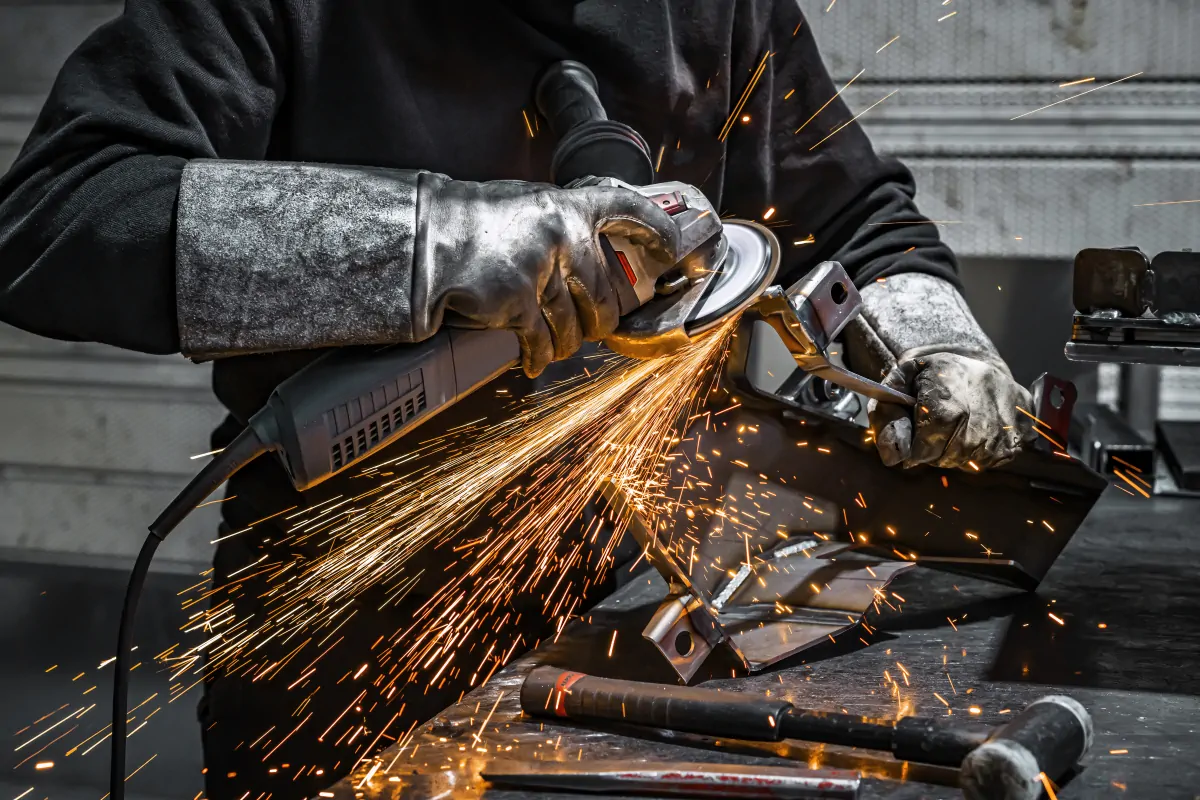


Weld finishing is a critical stage in the fabrication of metal components after welding has been completed. In stainless and acid-resistant steel applications, it is about much more than appearance. Proper finishing helps remove excess material, smooth the joint area, reduce places where contaminants may accumulate, achieve the required surface roughness and prepare the material for further surface treatment.
This is particularly important in equipment manufactured for the food, pharmaceutical and chemical industries, where surface quality can directly affect hygiene, cleanability and long-term durability.
Not every weld requires the same type of finishing. A structural weld that will remain hidden may require very little post-processing, while an internal weld in a stainless steel process vessel may need to be ground flush, polished and finished to a specific surface roughness.
So what does proper weld finishing involve? Which methods are used for stainless steel, and which techniques are most commonly applied by GMM INOX?
What is weld finishing?
Weld finishing refers to the operations carried out after the welding process has been completed. The exact scope depends on the material, welding method, joint design and required final surface condition.
Depending on the application, the process may include:
- removing excess weld metal,
- rough and fine grinding,
- surface blending,
- polishing,
- removing heat tint,
- pickling,
- passivation,
- final surface inspection.
This does not mean that every weld should be completely ground flat.
A weld is a structural part of the joint, so the amount of material removed must always be consistent with the technical documentation, the function of the component and the fabrication procedure.
At GMM INOX, welding is part of a broader manufacturing process covering stainless steel structures, tanks, mixers and process equipment. For this reason, the final treatment of the weld is selected in relation to the complete product and its operating conditions.
More information about the technologies used by the company can be found on the GMM INOX welding services page.
Why is proper weld finishing so important?
Weld finishing is often associated primarily with improving appearance. In industrial fabrication, however, aesthetics are only one part of the process.
Correctly finished welds help create a surface that is suitable for the intended use of the component. The process can reduce sharp edges, irregularities and recesses that may make cleaning more difficult.
On visible components, it can also create a more uniform finish and make the welded joint blend naturally into the surrounding material.
The issue becomes even more important with stainless steel.
The heat generated during welding can produce characteristic discoloration in the heat-affected zone. These colours may range from straw and brown to purple or blue. They are not simply cosmetic. Heat tint is associated with changes in the oxide layer at the surface, which may reduce corrosion resistance in the affected area.
For demanding stainless steel applications, the surface should therefore be properly cleaned and treated after welding.
Why stainless steel weld finishing requires special care
Stainless steel relies on a very thin passive layer for its corrosion resistance.
Welding affects this surface condition. Oxides and heat tint form in the area exposed to elevated temperatures, which means that mechanical smoothing alone is not always sufficient.
Depending on the application, the surface may also require chemical treatment such as pickling or passivation.
This is especially important for equipment used in contact with food, chemicals or pharmaceutical products. In such applications, the surface must not only look uniform. It must also support cleaning, hygiene and the specific requirements of the process.
How to finish a weld correctly – step by step
Proper finishing should begin with an assessment of the completed weld.
Grinding should never be started simply because the bead protrudes above the surface. First, it is necessary to define the required final condition and determine how much material can safely be removed.
1. Inspect the completed weld
Before any surface finishing begins, the quality and geometry of the joint should be checked.
The inspection may include:
- weld continuity,
- bead shape,
- excessive reinforcement,
- spatter,
- visible surface imperfections,
- conformity with technical drawings.
This is important because grinding should not be used to hide welding defects.
At GMM INOX, completed welds are subject to quality control, including visual inspection and verification against technical documentation.
2. Remove excessive weld reinforcement
If the specification requires the weld to be blended into the parent material, the first finishing step is the controlled removal of excess weld metal.
This is a roughing stage, but it still requires precision.
The objective is not to remove as much material as possible in the shortest time. The weld should be brought to the required geometry without creating depressions in the surrounding base material.
Excessive grinding can locally reduce wall thickness and create an uneven surface that is more difficult to correct later.
3. Grind and blend the weld
Once the excess material has been removed, the weld can be ground and blended more precisely.
A sequence of progressively finer abrasives is typically used so that scratches produced during rougher operations are gradually replaced by a finer and more uniform surface pattern.
Depending on component geometry, this may involve:
- angle grinders,
- straight grinders,
- belt grinders,
- flap discs,
- fibre discs,
- abrasive belts,
- non-woven abrasives.
The right tool should be selected according to the shape of the component and the required finish rather than simply according to removal speed.
Should you always start with a very coarse abrasive?
No.
This is one of the most common mistakes in weld finishing.
A coarse abrasive removes material quickly, but it also leaves deeper scratches. Those scratches must then be removed in subsequent stages.
The best approach is therefore to use an abrasive that is aggressive enough for the task, but no more aggressive than necessary.
If the weld reinforcement is relatively small, starting with an excessively coarse disc may actually increase the total amount of finishing work required.
Fine grinding – achieving a uniform surface
After the rough grinding stage, the process becomes much more controlled.
The purpose of fine grinding is to eliminate the marks left by the previous abrasive step until the required surface texture is achieved.
Large jumps between grit sizes should be avoided. A very fine abrasive may not be able to remove deep scratches left by a much coarser previous step.
The surface should be checked continuously throughout the process.
If individual deep scratches are still visible after moving to the next grit, polishing should not begin yet. Those defects should first be removed at the grinding stage.
Weld finishing methods most commonly used by GMM INOX
GMM INOX specialises in stainless and acid-resistant steel fabrication, including equipment for the food, pharmaceutical and other demanding industrial sectors.
As a result, weld finishing is not limited to quickly grinding down a visible weld bead.
Depending on the project specification, the methods most commonly used include precision weld grinding, surface polishing, pickling and passivation of stainless steel.
Precision weld grinding
Precision grinding is used when excess weld metal needs to be removed, the joint has to be blended into the surrounding surface or the component must be prepared for further finishing.
In selected GMM INOX projects, internal welds that come into contact with the process medium are ground flush with the parent material.
This creates a more uniform internal surface and reduces areas where product residues could accumulate.
GMM INOX also carries out projects requiring very low surface roughness values, down to Ra 0.4 μm.
Achieving this level of finish requires more than a single grinding operation. It involves a controlled sequence of finishing stages.
Stainless steel polishing
Polishing is another commonly used finishing method.
GMM INOX works with different surface finish requirements, from defined ground finishes to highly polished surfaces, depending on the project.
Polishing should only be carried out once the surface has been properly prepared. It is not intended to remove large weld irregularities.
If deep grinding marks remain after the previous stage, they may still be visible after polishing.
The correct sequence is therefore:
restore the required geometry → refine the surface → remove progressively finer scratches → polish to the required finish.
Pickling after welding
For stainless steel, pickling can be an important stage of post-weld treatment.
Its purpose is not to alter weld geometry, but to remove oxide scale, heat tint and certain surface contaminants created during welding.
This is an important distinction.
Grinding mechanically changes the surface and removes material. Pickling chemically cleans the stainless steel surface.
In demanding applications, the two processes may complement each other.
Stainless steel passivation
After the required mechanical and chemical treatment, the surface may also be passivated.
Passivation is not the same as polishing or pickling.
Its purpose is to support the formation of a stable passive surface condition responsible for the corrosion resistance of stainless steel.
For process equipment manufactured from stainless steel, particularly for demanding industrial environments, this can be an important part of the final treatment.
Grinding, polishing, pickling and passivation – what is the difference?
Although these processes are often used together, each has a different function.
Grinding removes material and corrects geometry.
Polishing produces a smoother and more uniform final finish.
Pickling removes oxides, heat tint and certain surface contaminants.
Passivation helps establish the correct passive surface condition of stainless steel.
In professional industrial fabrication, these are not competing processes. They are complementary methods used to achieve the required final condition of the component.
Why should heat tint be removed from stainless steel welds?
Discoloration around a weld is caused by high temperatures during welding.
The visible colours are created by changes in the oxide layer on the stainless steel surface.
In stainless steel components, severe heat tint can be associated with reduced corrosion resistance in the affected area. For this reason, demanding industrial applications require the surface to be properly treated after welding.
This is particularly important in:
- process tanks,
- piping systems,
- mixers,
- food-processing equipment,
- pharmaceutical equipment,
- components exposed to aggressive media.
The final treatment must therefore consider both appearance and corrosion performance.
Weld finishing in food-processing equipment
In the food industry, weld finishing has a direct impact on hygienic design.
Equipment surfaces should support effective cleaning and minimise locations where product residues can collect.
Unnecessary recesses, sharp transitions and irregularities can create areas that are more difficult to clean.
For this reason, tanks, mixers, process lines and similar equipment often require consistent surface quality across both the parent material and the welded area.
If the sheet surface has a defined roughness, the weld zone should not become an isolated area with a completely different finish.
The welding and finishing process should therefore be planned as one continuous manufacturing operation.
Weld finishing for pharmaceutical applications
Pharmaceutical and biotechnology applications can place even greater demands on surface quality.
In many projects, special attention is given to surfaces that come into direct contact with the product.
These surfaces may need to be finished in a way that:
- supports effective cleaning,
- minimises product retention,
- creates a uniform surface,
- achieves a specified roughness,
- meets hygienic process requirements.
One of the parameters used to describe surface quality is Ra, or average surface roughness.
The lower the Ra value, the smaller the average deviation of the surface profile.
Achieving very low roughness requires high-quality welding followed by controlled grinding and polishing.
GMM INOX has experience in precision finishing of stainless steel surfaces to values as low as Ra 0.4 μm, which is particularly relevant for demanding process applications.
Should every weld be ground flush?
No.
The correct finishing method must always be determined by the technical documentation and the function of the joint.
Grinding a weld unnecessarily can result in excessive material removal.
For structural joints, surface appearance alone should never determine the finishing method.
If the design requires a defined weld profile, that profile must be preserved.
In some process equipment applications, however, the opposite is true. A very uniform surface may be required, so the weld is intentionally ground flush with the parent material and then progressively finished to the required standard.
How to avoid overheating stainless steel during grinding
Grinding also generates heat.
Applying excessive pressure, staying in one area for too long or using the wrong abrasive can locally overheat the surface.
This may cause:
- new discoloration,
- poor surface appearance,
- additional oxide formation,
- difficulties in later finishing stages.
Grinding efficiency should therefore not be judged solely by material removal rate.
Temperature, geometry and scratch depth all need to remain under control.
Use dedicated tools for stainless steel
Another important rule when finishing stainless steel is to avoid contamination with particles of carbon steel.
Abrasives, wire brushes and other tools previously used on ordinary steel should not be used on stainless steel without proper control.
Iron particles transferred onto stainless steel may remain on the surface and later become corrosion initiation points.
Professional stainless steel fabrication therefore depends not only on the correct finishing method but also on proper workshop organisation and tool separation.
Common weld finishing mistakes
The most common errors include:
- using an unnecessarily coarse abrasive,
- removing too much weld metal,
- grinding into the parent material,
- making excessive jumps between abrasive grit sizes,
- leaving deep scratches before polishing,
- overheating the surface during grinding,
- using contaminated tools on stainless steel,
- leaving severe heat tint untreated,
- treating polishing as a substitute for pickling or passivation,
- selecting a finish based only on appearance rather than operating requirements.
Proper weld finishing therefore requires more than skill with a grinder. It also requires knowledge of the material, welding process, surface requirements and the final application of the component.
A good weld reduces the amount of finishing required
The quality of the final surface starts during welding.
The better controlled the weld geometry, the less mechanical correction is required afterwards.
This is especially important for stainless steel, where unnecessary grinding can increase the number of finishing stages needed to restore a uniform surface.
GMM INOX uses technologies such as TIG welding to produce precise joints in stainless and acid-resistant steels. Selected projects may also involve orbital welding under an argon shielding atmosphere.
For more information about the technologies and capabilities available, see GMM INOX welding services.
How should the weld finishing method be selected?
There is no single method suitable for every application.
The process should be selected according to:
- material grade,
- component function,
- operating environment,
- required surface roughness,
- hygienic requirements,
- corrosion resistance requirements,
- project documentation,
- final visual finish.
For one component, inspection and light cleaning may be sufficient.
For another, the weld may need to be blended flush with the sheet.
A more demanding project may require several grinding stages, polishing to a defined Ra value, followed by pickling and passivation.
For this reason, weld finishing should be treated as part of the manufacturing technology, not as a purely cosmetic operation performed at the end of production.
Weld finishing at GMM INOX
GMM INOX specialises in the manufacture and processing of stainless and acid-resistant steel equipment and components.
Projects include tanks, mixers, structures and process equipment for the food, pharmaceutical and other industrial sectors where high manufacturing quality is essential.
This allows welding, weld treatment and surface finishing to be handled as connected stages of one production process.
Depending on project requirements, GMM INOX uses precision weld grinding, polishing and chemical surface treatment, including pickling and passivation of stainless steel.
This makes it possible to adapt the final surface not only to the expected appearance, but also to technical parameters and the environment in which the finished equipment will operate.
If your project requires precise stainless steel fabrication and high-quality welded joints, explore GMM INOX welding services and discuss your technical requirements with our team.

