

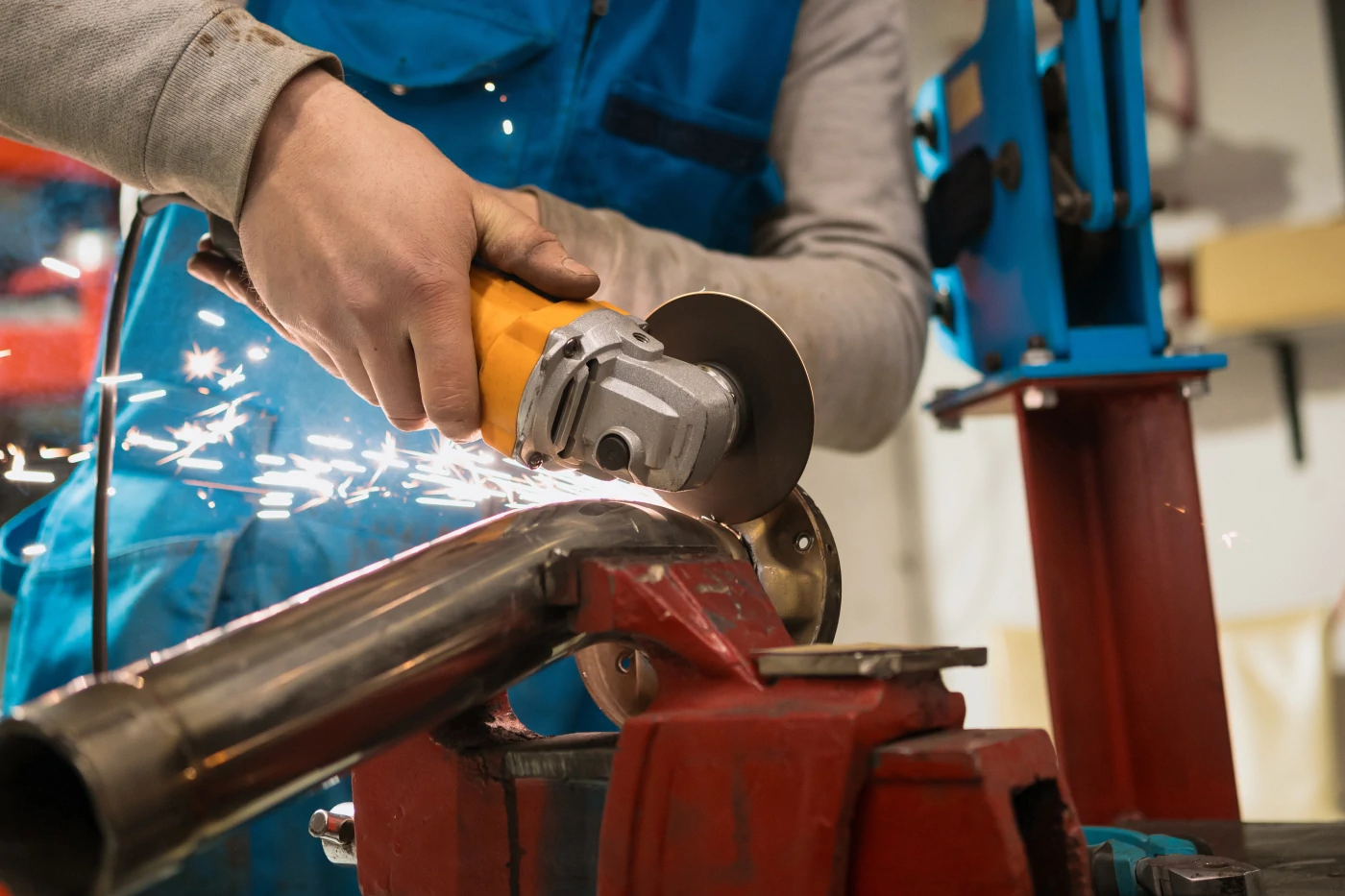


Stainless steel is a material widely used in the food, pharmaceutical, chemical, technological, and machinery industries. Its corrosion resistance, durability, aesthetics, and ability to operate under demanding conditions make it ideal for manufacturing tanks, housings, guards, structural elements, pipelines, process equipment, and specialized custom parts.
One of the key stages in processing this material is stainless steel bending on a CNC press brake. This process allows sheets to be formed into specific shapes without the need for welding or additionally joining multiple components. As a result, durable, aesthetic, and repeatable components can be achieved, which then proceed to further processing, assembly, or direct application in industrial equipment.
At GMM INOX, press brake bending is part of a broader technological capability that includes welding services, sheet rolling, laser cutting, and the design of equipment and details. The company delivers stainless steel solutions for the pharmaceutical and food industries, combining experience with modern technology.
What Is Stainless Steel Bending?
Stainless steel bending is a plastic forming process in which a sheet of metal is deformed at a specific angle. The material is not cut, but rather formed between a punch and a die. This results in a part with the designed geometry, maintaining material continuity and appropriate structural rigidity.
In practice, bending is most frequently performed on a CNC press brake. Numerical control allows for the precise setting of machine operating parameters, control over bending angles, and the maintenance of component repeatability in both single-unit and serial production. On the GMM INOX website, the bending service is described as precise plastic processing of sheet metal, consisting of forming metal between a punch and a die using digital control to achieve repeatable shapes.
Press brake bending finds application in the production of elements such as:
technical guards,
stainless steel housings,
structural elements,
brackets and handles,
mounting profiles,
machine parts,
tank components,
details for process equipment,
components for the food industry,
components for the pharmaceutical industry,
elements of pipelines and technological installations.
In the case of GMM INOX, sheet metal bending is not an isolated service, but an important stage in the comprehensive production of stainless steel elements and equipment. The company manufactures, among other things, process tanks, technological and storage tanks, technological and industrial pipelines, mixers, agitators, lifting columns, and pharmaceutical gloveboxes.
Why Does Stainless Steel Require a Precise Approach to Bending?
Stainless steel differs from standard structural steel. It is more demanding to process, which is why the bending process should be properly planned as early as the design stage. Not only is the bending angle itself important, but also the material grade, sheet thickness, bend radius, rolling direction, expected accuracy, and the subsequent application of the component.
For industrial components, errors during the bending stage can cause assembly issues, deteriorated aesthetics, welding difficulties, and even reduced functionality of the entire device. This applies particularly to tanks, guards, housings, process elements, and details operating in environments that require high chemical resistance or hygiene.
Material Springback
One of the most important phenomena during the bending of stainless steel is springback. After the bend is executed, the material partially returns toward its original shape. This means that achieving the target angle requires appropriate compensation.
In practice, the press brake operator must account for the material’s behavior and select parameters so that the finished part matches the technical documentation. In serial production, repeatability is of particular importance, as every element should share identical angles, radii, and dimensions.
Higher Bending Force
Stainless steel usually requires greater bending force than mild steel of a similar thickness. This influences the choice of machine, tooling, and technological parameters. Incorrectly selected force or dies can lead to deformations, excessively large radii, angle issues, or surface damage.
Surface Sensitivity
Stainless steel is frequently a visible material in the final product. This is especially true for equipment destined for the food and pharmaceutical industries, where it is not just durability that matters, but also cleanliness of execution, aesthetics, and the ease of maintaining the surface in an appropriate condition.
During bending, the risk of scratches, dents, and contamination must be minimized. For brushed or decorative surfaces, it is also necessary to establish the visible side of the component.
What Materials Can Be Bent on a Press Brake?
GMM INOX indicates that CNC press brake bending technology allows for the effective shaping of parts made from stainless steel, acid-resistant steel, and aluminum. In the context of industrial projects, however, stainless and acid-resistant steels are of the greatest importance, as they form the foundation of many devices, tanks, and process installations.
Stainless Steel
Stainless steel is utilized wherever corrosion resistance, durability, and surface cleanliness are required. It performs well in machine parts, guards, housings, structures, installations, and components that come into contact with moisture or cleaning agents.
Acid-Resistant Steel
Acid-resistant steel finds application in more demanding environments, including the food, pharmaceutical, chemical, and process industries. On its process tanks page, GMM INOX highlights the execution of solutions using 316L stainless and acid-resistant steel, which ensures corrosion resistance and a long service life.
Aluminum
Aluminum is lighter than steel and works well in components where structural weight is a key factor. However, it requires a different technological approach, as it reacts differently to bending and has distinct requirements regarding radii and processing parameters.
Stainless Steel Bending in the Production of Industrial Equipment
In many companies, sheet metal bending is performed as a single, isolated operation. At GMM INOX, it sits within a broader context, as the company handles the production and processing of stainless steel components for demanding industries. This means that bending can be a single phase in the realization of a larger project, such as a tank, a technological device, an installation element, or a specialized custom detail.
For an industrial client, this is highly significant. Instead of outsourcing the design, cutting, bending, welding, and assembly to several different subcontractors, the entire process can be anchored with a single contractor who understands the complete manufacturing technology of the component.
This approach is particularly crucial in the production of:
process tanks,
technological tanks,
storage tanks,
mixers,
agitators,
pharmaceutical gloveboxes,
technological pipelines,
stainless steel structures,
individually designed details,
components for the food and pharmaceutical industries.
GMM INOX describes its process tanks as solutions designed and executed according to the technological requirements and needs of production plants. The company also emphasizes handling the process from design to the finished device.
What Affects the Quality of Stainless Steel Bending?
Bending quality depends on many factors. The CNC press brake itself is highly important, but it does not replace technological expertise, correct design, and knowledge of the material.
1. Stainless Steel Grade
Different steel grades have varying capabilities for bending. Stainless steel used in standard technical components behaves differently compared to acid-resistant steel used in chemical, food, or pharmaceutical environments.
It is highly beneficial to clearly specify the material grade in the request for quotation (RFQ). If the client is unsure which material will be best, the manufacturer can help select a solution tailored to the working environment, hygienic requirements, chemical resistance, and operational conditions.
2. Sheet Thickness
Sheet thickness affects the bending force, bend radius, and the ability to achieve specific geometries. The thicker the material, the greater the demands placed on the machine and tooling. If the radius is too small, excessive material stretching can occur on the outer side of the bend.
3. Bend Radius
The bend radius should be matched to the material, sheet thickness, and the function of the component. Designing a part without considering the realistic bend radius can lead to discrepancies between the digital model and the finished product.
In practice, the radius affects:
the aesthetics of the part,
the structural strength of the element,
dimensional accuracy,
feasibility of subsequent assembly,
the correctness of the sheet metal flat pattern development,
edge quality after bending.
4. Rolling Direction
Sheet metal has a specific rolling direction that can influence how the material behaves during bending. For more demanding industrial components, it is worth considering this parameter as early as the design and material nesting stage.
5. Tool Selection
The punch and die must be chosen according to the thickness, grade, and expected bend radius. An inappropriate toolset can cause deformations, surface marks, inaccurate angles, or repeatability issues.
6. Technical Documentation
The more accurate the documentation, the lower the risk of errors. For industrial components, documentation should include not only dimensions but also information about the material, tolerances, the visible side, radii, angles, and the subsequent application of the part.
How to Prepare an Inquiry for Stainless Steel Bending?
A well-prepared inquiry speeds up the quoting process and helps prevent misunderstandings. For industrial orders, it is best to provide as much technical information as possible right from the start.
In your inquiry, it is worth including:
the specific grade of stainless or acid-resistant steel,
sheet thickness,
quantity (number of pieces),
component dimensions,
bending angles,
bend radii,
dimensional tolerances,
information regarding the visible side,
surface finish specifications,
DXF, DWG, STEP, or PDF files,
information on whether the element will later be welded, assembled, or ground,
information about the industry and operational conditions of the component.
For more complex projects, providing a 3D model is also recommended. This allows for checking the part’s geometry, the sequence of bends, potential collisions, and the feasibility of manufacturing the detail according to assumptions.
The Most Common Errors in Designing Bent Stainless Steel Components
Excessively Small Bend Radius
One of the most frequent errors is designing components with a radius that is impossible to achieve given the thickness and material grade. A radius that is too small can cause cracking, deformation, or deterioration of the surface aesthetics.
Holes Placed Too Close to the Bend Line
If holes, notches, or cutouts are located too close to the bend line, they may become deformed. In mounting components, this can make proper fitting of parts impossible.
Lack of Information About the Representative (Visible) Side
In stainless steel, the visible side is often highly important. If the detail is to be part of an equipment unit, housing, panel, or exposed element, the manufacturer needs to know which surface must be protected with extra care.
Missing Tolerances or Excessively Strict Tolerances
A lack of specified tolerances can lead to misunderstandings, while overly strict tolerances without justification can unnecessarily drive up production costs. It is best to define accuracy precisely where it has real assembly or technological significance.
No Information About Further Processing
If the component is to be welded, ground, passivated, assembled, or joined with other parts after bending, it is highly beneficial to state this at the inquiry stage. This allows for choosing the correct sequence of operations.
Where Are Bent Stainless Steel Components Used?
Bent stainless steel components are utilized in many areas of industry. In the case of GMM INOX, sectors where durability, hygiene, chemical resistance, and precision execution matter are particularly important.
Food Industry
In the food industry, stainless steel is utilized due to its corrosion resistance, ease of cleaning, and ability to operate in demanding environments. Bent elements can form parts of tanks, guards, support structures, technological devices, and process installations.
Pharmaceutical Industry
In the pharmaceutical industry, particular emphasis is placed on surface quality, precision execution, and the ability to maintain high standards of cleanliness. GMM INOX indicates that it creates stainless steel equipment for both the pharmaceutical and food industries.
Chemical and Process Industry
In chemical environments, the material must be resistant to the action of specific substances. In such projects, selecting the appropriate steel grade—such as acid-resistant steel—and the quality of component execution are of paramount importance.
Machinery and Equipment Manufacturing
Bent stainless steel details can perform structural, protective, or mounting functions. They are used in housings, guards, brackets, panels, bases, and equipment components.
Why Choose a Company Specialized in INOX for Stainless Steel Bending?
Bending stainless steel requires a different approach than bending standard steel sheets. What matters is knowledge of the material, proper parameter selection, surface protection, and experience working with industrial projects.
GMM INOX specializes in stainless steel solutions, and press brake bending is a component of a wider technological offering. The company delivers both individual custom details and larger industrial projects where bending is integrated with cutting, rolling, welding, and design.
Choosing such a manufacturer is particularly significant when:
the detail must be executed with high accuracy,
the component will be part of a larger machine or device,
the material used is stainless or acid-resistant steel,
surface aesthetics are important,
the project requires subsequent welding or assembly,
repeatability is required in serial production,
the element will operate in an industrial environment,
technological advisory is valuable during the design stage.
Stainless Steel Bending vs. the Production of Tanks and Process Equipment
In the case of tanks and process equipment, bending is often just one of the steps in preparing components. Elements must be shaped correctly so they can later be joined into a larger structure. This applies to shells, jackets, guards, covers, reinforcing elements, brackets, and mounting details.
GMM INOX designs and manufactures stainless steel process tanks tailored to the technological requirements and needs of production plants. The company highlights the individual customization of solutions, durability, and operational safety under industrial conditions.
In such projects, bending must align not only with the technical drawing but also with the subsequent welding, assembly, and operating technology. Therefore, a comprehensive approach—where design, processing, and execution are completely aligned—is vital.
What Influences the Price of Stainless Steel Bending?
The price of stainless steel bending depends on a variety of factors. It cannot be reliably determined without analyzing the documentation, the type of material, and the volume of components.
The cost of the service is influenced by:
the specific grade of stainless steel,
sheet thickness,
dimensions of the component,
length of the bend line,
number of bends,
complexity of the geometry,
required accuracy,
number of pieces (volume),
the necessity of preparing the CNC program,
surface protection requirements,
the need to produce a prototype,
additional processes such as laser cutting, rolling, welding, or grinding.
In serial production, the unit cost is often lower because the program preparation, machine setup, and testing are distributed across a larger number of components. For single custom details, technological preparation accounts for a larger share of the price.
What Does Professional Service Execution Look Like?
A professional stainless steel bending process should consist of several distinct stages.
1. Documentation Analysis
At the beginning, the manufacturer analyzes drawings, models, material grades, thicknesses, radii, and tolerances. If the design carries any technological risks, these should be discussed before production begins.
2. Technology Selection
At this stage, the tooling, bending parameters, sequence of operations, and methods of surface protection are selected.
3. CNC Programming
Data is entered into the machine’s control system. In serial production, this program can be saved and reused for subsequent batches of details.
4. Execution of Bending
The operator executes the bend according to the documentation and technological parameters. If necessary, angle corrections are introduced to compensate for material springback.
5. Quality Control
The finished part must be checked for dimensions, angles, surface condition, and compliance with the documentation.
6. Further Processing
If the project requires it, the component moves to subsequent processes, such as welding, rolling, grinding, assembly, or kitting.
Summary
Stainless steel bending is a precise process that requires thorough knowledge of the material, an appropriate machinery park, and technological experience. For industrial components, it is not merely about achieving a specific angle. What also counts is repeatability, surface quality, compliance with documentation, subsequent weldability, and the perfect fit of the detail into the entire device or installation.
GMM INOX executes CNC press brake bending as part of its comprehensive stainless steel processing. The company integrates design, laser cutting, rolling, bending, and welding, delivering solutions for demanding sectors, including the food and pharmaceutical industries.
If you are planning the execution of stainless steel details, components for process equipment, tanks, guards, housings, or industrial structures, it is highly recommended to prepare the technical documentation, specify the material grade, quantity, tolerances, and surface requirements right at the inquiry stage. This ensures that the quoting and manufacturing process runs smoothly, and the finished component aligns perfectly with all technical and operational expectations.

