



Stainless steel is one of the most widely used materials in modern industry. It is found in process pipework, tanks, machinery, industrial structures, food-processing equipment, pharmaceutical systems and many other applications where strength, hygiene and corrosion resistance are essential.
However, welding stainless steel is not simply a matter of joining two pieces of metal. The process must be carefully controlled if the finished joint is to retain the properties that make stainless steel so valuable in the first place.
Too much heat, poor shielding, incorrect filler metal or inadequate preparation can result in distortion, oxidation, discolouration and reduced corrosion resistance.
So, what is the best way to weld stainless steel? When should TIG welding be used, and when is MIG/MAG the better option? Which shielding gas is suitable? How important is root protection when welding stainless steel pipe?
This guide explains the most important aspects of stainless steel welding, from process selection and preparation through to post-weld treatment and quality control.
What is stainless steel?
Stainless steel is a family of alloy steels containing sufficient chromium to form a thin protective oxide layer on the surface of the material.
This passive layer is what gives stainless steel its characteristic resistance to corrosion.
Depending on the alloy composition and microstructure, stainless steels may be classified as austenitic, ferritic, martensitic, duplex or super duplex.
Different grades behave differently during welding. For that reason, there is no single welding procedure that is suitable for every type of stainless steel.
The correct welding approach depends on factors such as material grade, wall thickness, joint design, operating environment, service temperature and corrosion requirements.
Why does stainless steel require careful welding?
Stainless steel can have excellent weldability, but the welding process must be properly controlled.
The main challenge is heat.
During welding, the material is exposed to very high local temperatures. If the heat input is excessive, or if the weld pool is not properly protected from the atmosphere, the surface may oxidise and the corrosion resistance of the material may be affected.
Poor welding practice can also result in distortion, porosity, lack of fusion, excessive heat tint or an unacceptable weld profile.
For industrial applications, a good stainless steel weld must therefore be assessed not only for strength but also for its effect on the surrounding material.
GMM INOX provides professional welding services for stainless steel, acid-resistant steel and structural steel, using processes selected according to the requirements of each project.
Which welding methods are suitable for stainless steel?
A number of welding processes can be used for stainless steel, although TIG and MIG/MAG are among the most common in industrial fabrication.
TIG welding
TIG offers excellent control over the weld pool, heat input and appearance of the finished weld.
It is particularly suitable for thin material, pipework, process installations, tanks and components where precision and weld quality are especially important.
MIG/MAG welding
MIG/MAG offers greater welding speed and productivity.
It is often used for larger components, thicker sections, long weld runs and production work where efficiency is an important consideration.
MMA welding
Manual Metal Arc welding can also be used for stainless steel in certain applications.
However, in precision fabrication and process-industry work, TIG and MIG/MAG are generally more widely used because they offer greater control, consistency and productivity.
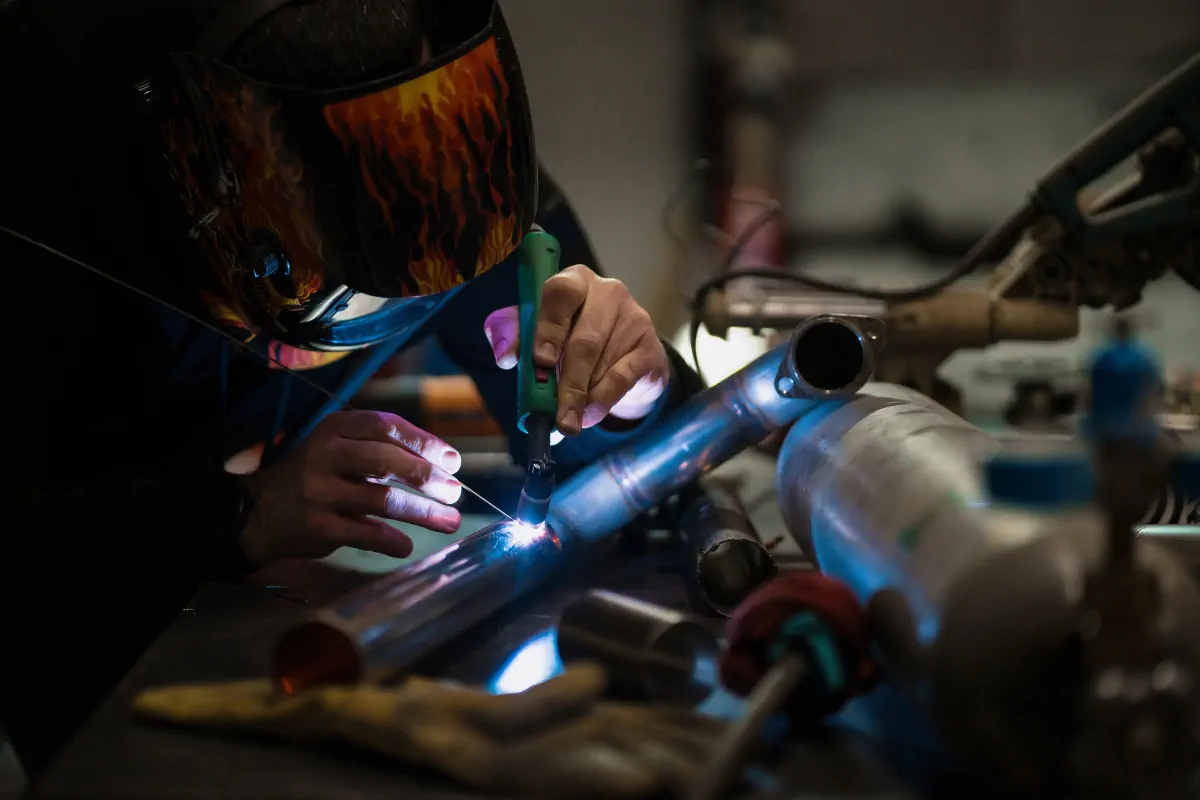
TIG welding stainless steel
TIG is one of the most widely used processes for high-quality stainless steel welding.
An electric arc is formed between a non-consumable tungsten electrode and the workpiece. The weld pool is protected by a shielding gas, typically argon, while filler metal can be added separately if required.
The major advantage of TIG is control.
The welder can manage the size of the weld pool, travel speed, penetration, filler addition and heat input with a high degree of precision.
This makes TIG particularly suitable for work where both weld integrity and appearance matter.
GMM INOX carries out stainless steel and acid-resistant steel welding using TIG 141 where this process is appropriate for the application.
Where is TIG commonly used?
TIG welding is especially well suited to stainless steel pipework, tanks, process equipment, machinery components and hygienic installations.
It is also widely used in the food, pharmaceutical, chemical and cosmetic industries, where weld quality and cleanability can be critical.
MIG/MAG welding stainless steel
MIG/MAG welding is generally faster than TIG and can offer significantly higher productivity.
In this process, the welding wire acts as both the electrode and the filler metal. It is continuously fed through the welding torch into the weld pool.
For stainless steel fabrication, the process is particularly useful for larger components, thicker material, long weld runs and repeat production.
The choice of wire and shielding gas must be appropriate for the stainless steel grade being welded.
Can stainless steel be MIG welded?
Yes.
Stainless steel can be welded using the MIG process, provided that the correct stainless steel wire and suitable shielding gas are used.
Using wire intended for mild steel would not provide the same metallurgical or corrosion-resistant properties and may compromise the finished joint.
TIG or MIG/MAG – which is better for stainless steel?
Neither method is universally better.
The right process depends on the component being manufactured and the performance required from the weld.
| Requirement | TIG | MIG/MAG |
| Precision | Excellent | Very good |
| Weld appearance | Excellent | Very good |
| Productivity | Moderate | High |
| Thin sheet | Excellent | Good |
| Thicker sections | Suitable | Excellent |
| Stainless pipework | Very common | Application dependent |
| Long weld runs | Less productive | Highly productive |
| Heat control | Excellent | Very good |
TIG is often preferred where precision, appearance and heat control are the priority.
MIG/MAG is usually more suitable where productivity, deposition rate and welding speed are more important.
For industrial fabrication, the process should always be selected around the job rather than forcing a particular welding method onto every project.
GMM INOX can select the appropriate process as part of its professional welding services.
What equipment is used for welding stainless steel?
High-quality stainless steel welding depends on much more than the welding power source itself.
The complete process must take account of the welding machine, shielding gas, filler wire or rod, electrode type, current, voltage, travel speed, joint preparation and welding sequence.
All of these variables can affect the final weld.
The filler metal is particularly important.
It must be selected according to the stainless steel grade and the service conditions of the finished component.
Using an unsuitable filler simply because it is described as “stainless” is not good welding practice.
Choosing filler metal for stainless steel
Common stainless steel filler-metal families include 308, 309 and 316.
However, the correct grade depends on the parent material, the environment in which the part will operate and the level of corrosion resistance required.
The filler metal may also need to be selected differently when joining dissimilar materials.
That is why professional fabrication starts with identifying the exact material grades rather than treating all stainless steels as interchangeable.
Which shielding gas is used for stainless steel welding?
Shielding gas protects the molten weld metal from oxygen, nitrogen and other elements in the surrounding atmosphere.
Poor shielding can lead to oxidation, contamination and weld defects.
Shielding gas for TIG welding
Argon is the most commonly used shielding gas for TIG welding stainless steel.
It provides stable arc characteristics and effective protection for the electrode and weld pool.
Shielding gas for MIG welding
MIG welding uses carefully selected shielding-gas mixtures.
The exact composition depends on the process, transfer mode, material thickness and required weld characteristics.
The choice of gas can influence arc stability, penetration, spatter levels, weld profile and overall appearance.
Why is root protection important when welding stainless steel pipe?
When a stainless steel pipe is welded, the torch protects the face of the weld, but the reverse side of the joint is also exposed to very high temperatures.
Without adequate protection, oxygen can react with the hot metal and cause heavy oxidation at the weld root.
In demanding pipework applications, this is often unacceptable.
For that reason, an inert gas purge is frequently introduced inside the pipe.
The purpose of root purging is to protect the reverse side of the weld while it is hot.
This is particularly important in food-processing, pharmaceutical, chemical and other hygienic process systems where the internal weld surface may come into direct contact with the product or process medium.
How should stainless steel be prepared before welding?
Surface preparation has a major influence on weld quality.
Before welding, the joint area should be free from oil, grease, dirt, moisture and residues from previous manufacturing operations.
Contamination can cause porosity, lack of fusion, poor appearance and other welding defects.
Avoid contamination from carbon steel
Stainless steel should also be protected from contamination by ordinary carbon steel.
Grinding discs, wire brushes, tools and work surfaces previously used on carbon steel can transfer iron particles onto stainless steel.
These particles may later rust and create localised corrosion on a surface that would otherwise remain resistant.
For this reason, fabrication shops working professionally with stainless steel normally use dedicated tools and abrasives for stainless materials.
Why is heat input so important?
Heat control is one of the most important aspects of stainless steel welding.
Excessive heat can lead to greater distortion, heavier oxidation, wider heat-affected zones and undesirable changes in the surface condition of the material.
Heat input is not controlled simply by reducing welding current.
Travel speed, arc length, joint geometry, welding sequence, number of passes and interpass temperature can all influence the total amount of heat entering the component.
Good welding practice therefore requires the entire process to be planned.
Why does stainless steel distort during welding?
All metals expand when heated and contract when they cool.
Welding concentrates a large amount of heat in a relatively small area, so the heating and cooling cycle is highly localised.
If this process is not properly controlled, the component may move, twist or bow.
Thin stainless steel sheet is especially susceptible to distortion.
Distortion can be reduced by proper fit-up, tack welding, clamping, balanced welding sequences and controlled heat input.
For larger fabricated components, distortion control should be considered before welding begins rather than corrected only after the part has been completed.
Welding stainless steel pipe
Stainless steel pipe welding is one of the more demanding areas of stainless steel fabrication.
The joint may need to achieve several objectives at the same time: mechanical strength, leak tightness, full penetration, correct geometry, corrosion resistance and a smooth internal surface.
These requirements are particularly important in process systems used in the food, pharmaceutical and chemical industries.
A rough or heavily oxidised internal weld may not only affect corrosion resistance but may also make a system more difficult to clean.
For this reason, stainless steel pipe welding requires careful control of joint preparation, root protection, heat input, filler metal and welding parameters.
GMM INOX provides welding services for stainless steel components and industrial installations where the welding process is selected to meet the technical requirements of the project.
Welding acid-resistant stainless steel
The terms “stainless steel” and “acid-resistant steel” are sometimes used interchangeably, but they do not mean exactly the same thing.
Acid-resistant stainless steels are designed for use in more aggressive chemical environments.
Grades containing molybdenum, such as those in the 316 family, are a common example.
When welding these materials, particular attention must be paid to the exact steel grade, filler material, operating temperature, process medium and corrosion requirements.
A weld that is mechanically sound may still be unsuitable if the selected consumable or welding procedure does not provide the required corrosion performance.
Common problems when welding stainless steel
The most frequent problems include excessive heat input, inadequate gas coverage, poor root shielding, incorrect filler-metal selection, contaminated surfaces, cross-contamination from carbon steel and poorly prepared joints.
Excessive heat can cause distortion and heavy discolouration.
Poor gas shielding can expose the molten metal to the atmosphere and result in oxidation.
Insufficient root protection can cause severe oxidation on the inside of stainless steel pipe.
An unsuitable filler metal can reduce the mechanical or corrosion-resistant properties of the joint.
Contaminants such as oil or grease can cause porosity and other weld defects.
Tools previously used on mild steel can introduce free iron onto the stainless surface.
Finally, incorrect joint geometry may make it impossible to achieve reliable penetration and fusion.
Heat tint after welding stainless steel
Yellow, brown, purple or blue discolouration around a stainless steel weld is commonly referred to as heat tint.
It forms when the hot surface reacts with oxygen.
Heat tint should not always be regarded as a purely cosmetic issue.
Heavy oxidation may indicate that the protective surface condition has been affected.
Depending on the application, the oxide layer may need to be removed after welding.
Post-weld treatment of stainless steel
Welding is not always the final operation.
Depending on the specification and intended use, stainless steel components may require mechanical cleaning, grinding, pickling, passivation or polishing.
Pickling
Pickling is used to remove oxide scale and heat tint from the surface after welding.
Passivation
Passivation helps restore and optimise the protective passive surface condition of stainless steel.
Polishing
Polishing may be required where a very smooth surface is needed, for example in hygienic equipment or applications where easy cleaning is essential.
The finishing method should always be selected according to the requirements of the finished component.
Where is stainless steel welding used?
Stainless steel welding is used across a wide range of industries.
Typical applications include tanks, pressure and process vessels, stainless steel pipework, mixing equipment, machine components, industrial structures and hygienic process systems.
In the food industry, stainless steel is valued for its durability, corrosion resistance and ease of cleaning.
In pharmaceutical manufacturing, surface condition, weld quality and hygienic design can be particularly important.
In chemical processing, suitable stainless steel grades are selected to withstand aggressive media.
The same material is also widely used in machinery, fabrication and specialist industrial equipment.
How is weld quality assessed?
An attractive weld is not necessarily a technically acceptable weld.
Depending on the project, inspection may consider weld profile, penetration, undercut, porosity, cracking, surface imperfections and compliance with the technical documentation.
More demanding applications may require additional testing or inspection procedures according to the applicable standards and customer specification.
For professional fabrication, quality control should form part of the manufacturing process rather than being treated as an afterthought.
Professional stainless steel welding by GMM INOX
For industrial fabrication, welding should not be viewed simply as the act of joining two pieces of metal.
It forms part of a wider manufacturing process covering material preparation, process selection, welding, inspection, finishing and final quality control.
GMM INOX provides professional stainless steel welding services for stainless, acid-resistant and structural steels.
The company works with technologies including TIG 141 and MIG/MAG 131/135 and undertakes both individual components and more complex industrial assemblies.
Projects may include stainless steel structures, tanks, pipework, machinery components, process installations and equipment for industries such as food processing and pharmaceuticals.
For components where repeatability, weld quality, dimensional accuracy and surface finish are critical, working with an experienced stainless steel fabricator can significantly reduce the risk of problems later in the production process.
How to choose a stainless steel welding company
Price should not be the only factor when choosing a welding contractor.
A capable supplier should understand the stainless steel grades being used, select an appropriate welding process, work to technical drawings, maintain suitable production facilities, control weld quality and understand the specific requirements of the customer’s industry.
This is especially important for food, pharmaceutical and chemical applications, where weld quality and surface condition can directly affect the performance and cleanability of the finished equipment.
Summary
Successful stainless steel welding depends on much more than having the right welding machine.
The quality of the finished joint is influenced by the stainless steel grade, welding process, shielding gas, filler metal, heat input, joint preparation, root protection, welding sequence, post-weld treatment and quality control.
TIG is often chosen where precision and excellent control are required, while MIG/MAG is well suited to applications where higher productivity is important.
For demanding industrial projects involving tanks, pipework, process equipment or stainless steel structures, professional stainless steel and acid-resistant steel welding by GMM INOX provides access to the process knowledge and manufacturing experience required to achieve reliable and repeatable results.

