

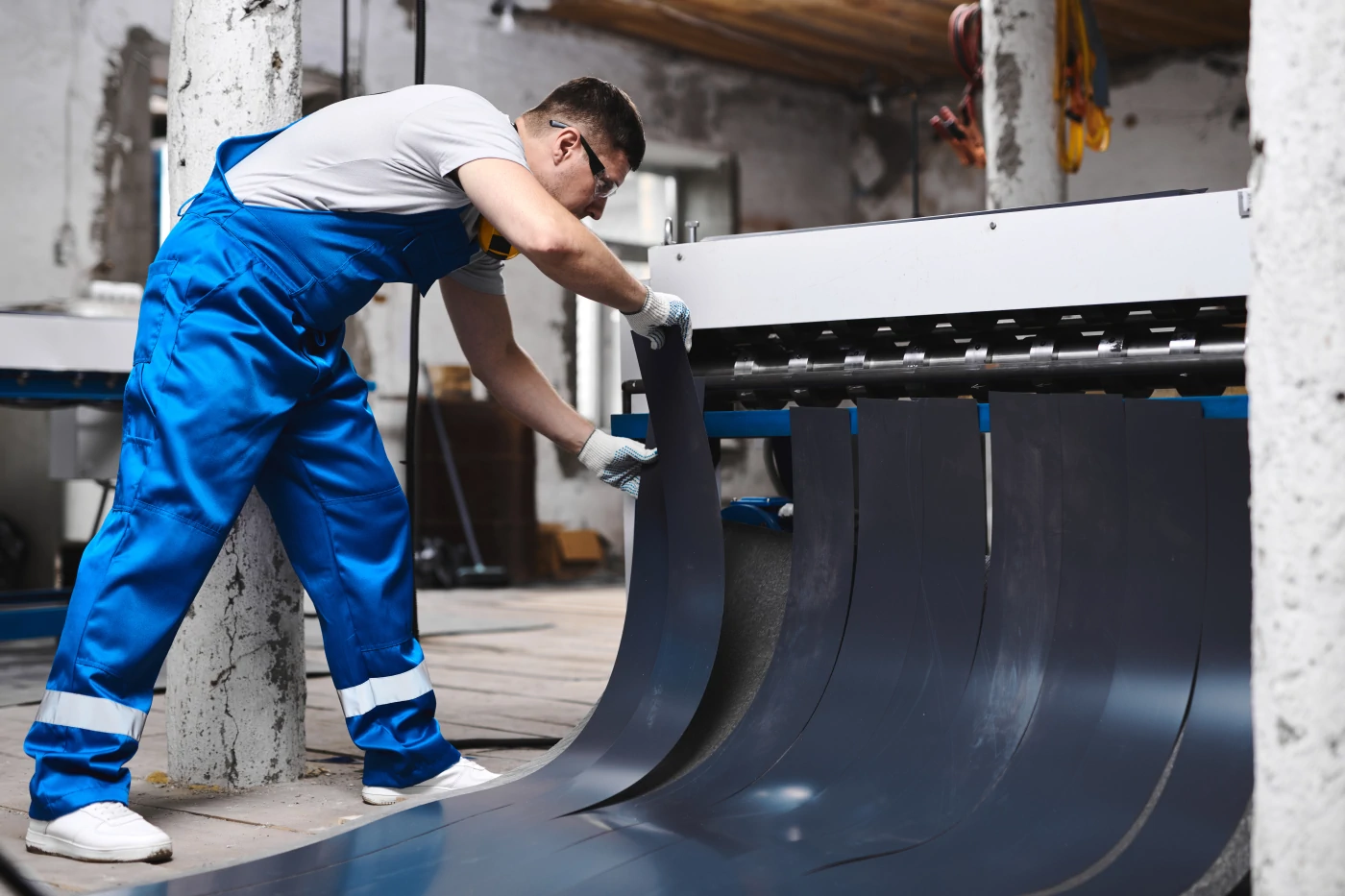


Sheet metal processing requires selecting the right technology for a specific project. Components with simple angles are manufactured differently from cylinders, tank shells, cones, or rounded industrial parts. Two processes that are often compared are sheet metal rolling and sheet metal bending. Although both are used to give the material a specific shape, they differ in their operating principle, final result, and application.
In practice, the choice between rolling and bending depends primarily on the intended shape of the finished component. If the project requires an arc, tube, tank shell, or a component with a radius, rolling is usually the right solution. If, however, the project involves bends at specific angles, sheet metal bending is used, most often on a press brake.
What does sheet metal rolling involve?
Sheet metal rolling is a plastic forming process in which a sheet of metal passes through a set of rollers. Under pressure, the material gradually takes on a defined shape, most often arched, cylindrical, or conical. This makes it possible to produce components with a high level of repeatability and precision.
Rolling is used when the sheet metal needs to be curved to a specific radius. This process is particularly effective in the production of:
- tank shells,
- tubes,
- cones,
- technical guards and covers,
- structural components,
- parts for industrial equipment,
- stainless steel and acid-resistant steel components.
At GMM INOX, sheet metal rolling is carried out according to project specifications, using modern machines and technologies that enable a high level of manufacturing accuracy.
What does sheet metal bending involve?
Sheet metal bending involves permanently deforming the material along a defined line. It is most commonly performed on a press brake, where the sheet metal is pressed by a punch into a die. As a result, a bend is formed at a specified angle.
Sheet metal bending is used when components with straight, clearly defined edges are required. This technology is well suited for producing:
- housings,
- profiles,
- brackets,
- angle sections,
- structural components,
- mounting details,
- machine and equipment parts.
Bending makes it possible to achieve a precise angle, but it is not used to form large radii or cylindrical components. This is where the main difference between bending and rolling becomes clear.
Sheet metal rolling vs. sheet metal bending – the key difference
Simply put, rolling is used to create rounded shapes, while bending is used to create bends at specific angles.
In the case of rolling, the sheet metal is gradually formed to a radius. The result may be, for example, a tube, a tank shell, or a cone. In the case of bending, the material is bent locally at a specific point, most often at a 90-degree angle or another angle defined in the project.
It can therefore be assumed that:
- rolling gives sheet metal an arched or cylindrical shape,
- bending gives sheet metal an angular shape,
- rolling affects a larger surface area of the material,
- bending concentrates deformation along a single line,
- rolling uses rollers,
- bending uses a press brake, punch, and die.
When should sheet metal rolling be chosen?
Sheet metal rolling is the right choice when a project requires a component with a rounded shape. This applies especially to industries that use tanks, industrial installations, pipelines, stainless steel components, and structures requiring high tightness and precision.
Rolling is worth choosing when you need to produce:
- a tank shell,
- a tube made from sheet metal,
- a cone,
- a cylindrical component,
- a part with a large radius,
- a rounded technical housing,
- a stainless steel or acid-resistant steel component.
This process is particularly important in the production of components for the food, pharmaceutical, chemical, and technology industries. In these sectors, not only the shape matters, but also surface quality, manufacturing precision, and the possibility of further processing, such as welding.
When is sheet metal bending the better solution?
Sheet metal bending is suitable when the component needs to have clearly defined edges, angles, or bends. It is a good choice for the production of technical details, housings, profiles, and mounting parts.
Bending is appropriate when the project involves producing:
- angle sections,
- closed or open profiles,
- machine guards,
- structural components,
- brackets,
- parts with one or more bends,
- components requiring a specific angle.
Unlike rolling, bending does not give the material a smooth arc over a larger surface area. Therefore, for cylindrical components, tanks, or tubes, rolling is the better solution.
Can rolling and bending be combined in one project?
Yes, in many industrial projects, both processes can complement each other. The same component may require both rounding and additional bends, edges, or mounting sections.
For example, when producing stainless steel components, the appropriate sheet metal shape can first be cut, then rolled, and later subjected to additional bending or welding. This makes it possible to obtain a finished component that complies with the technical documentation.
That is why, when choosing a contractor, it is worth paying attention not only to the rolling or bending service itself, but also to experience in comprehensive metal processing. GMM INOX offers a wide range of services related to stainless steel processing, including sheet metal rolling, laser cutting, press brake bending, detail design, and welding services.
What determines the choice of the right technology?
The choice of technology depends on several factors. The most important include the shape of the finished component, sheet thickness, material type, required radius, manufacturing tolerances, and subsequent production stages.
When choosing between rolling and bending, it is worth considering:
1. Component shape
If the component is to be cylindrical or arched, rolling is selected. If it is to have sharp bends and angles, bending will be the better option.
2. Material type
Carbon steel behaves differently from stainless steel, aluminium, or acid-resistant steel. Each material has a different susceptibility to deformation.
3. Sheet thickness
Material thickness affects the possible rolling radius and bending parameters. The thicker the sheet, the greater the technological requirements.
4. Radius or angle
In rolling, the radius is crucial. In bending, the most important factors are the bend angle and the length of the bend line.
5. Further processing
If the component will later be welded, assembled, or machined, this must be taken into account already at the design stage.
Rolling stainless and acid-resistant steel sheets
Rolling stainless and acid-resistant steel sheets requires a high level of precision and experience. These types of materials are often used in the food, pharmaceutical, and chemical industries, where corrosion resistance, hygiene, and structural durability are essential.
In such projects, proper material preparation, selection of rolling parameters, and repeatability are very important. Even minor deviations can affect subsequent welding, tightness, or assembly of the entire component.
For this reason, projects requiring high accuracy should be entrusted to a company that specializes in working with stainless steel. GMM INOX performs precise rolling of stainless and acid-resistant steel sheets, producing, among other things, tank shells, tubes, and cones in accordance with project requirements.
Sheet metal rolling or bending – which should you choose?
There is no single universal answer. Everything depends on the final result that needs to be achieved.
Choose sheet metal rolling if you need a component that is:
- round,
- arched,
- cylindrical,
- conical,
- made with a large radius,
- intended for a tank shell or tube.
Choose sheet metal bending if you need a component that is:
- bent at a specified angle,
- made with straight edges,
- profile-based in construction,
- intended as a housing, bracket, or mounting detail.
In many cases, the best solution is to obtain a technical consultation before production begins. This makes it possible to select the appropriate processing method, avoid design errors, and optimize the entire component manufacturing process.
Summary
Sheet metal rolling and sheet metal bending are two different metal forming processes. Although both make it possible to change the shape of the material, their applications differ. Rolling is suitable for rounded, cylindrical, and conical components, whereas bending is the best solution for parts with specific angles and bend lines.
If a project requires the production of a tank shell, tube, cone, or component with a defined radius, it is worth choosing professional sheet metal rolling. Properly selected technology makes it possible to obtain a precise, durable component that complies with documentation and is ready for further processing or assembly.

