



The types of welds and welded joints used in a project directly affect the strength, safety and manufacturability of a structure. The correct solution depends on several factors, including component geometry, material thickness, expected loads, welding process and technical requirements.
It is also important to distinguish between two terms that are often confused.
A welded joint describes how the parts are positioned in relation to one another, while a weld is the actual fused connection created between them.
At GMM INOX, this distinction is particularly important in the fabrication of stainless and acid-resistant steel equipment, tanks and industrial structures. More information about the processes we use can be found on the GMM INOX welding services page.
What is a weld?
A weld is the permanent connection created between two or more components during the welding process.
Its geometry and size must be selected according to the function of the finished structure.
The quality of a weld depends on factors such as:
- material grade,
- material thickness,
- edge preparation,
- welding process,
- welding position,
- process parameters,
- joint accessibility,
- load conditions,
- strength and leak-tightness requirements.
There is therefore no single weld type suitable for every application.
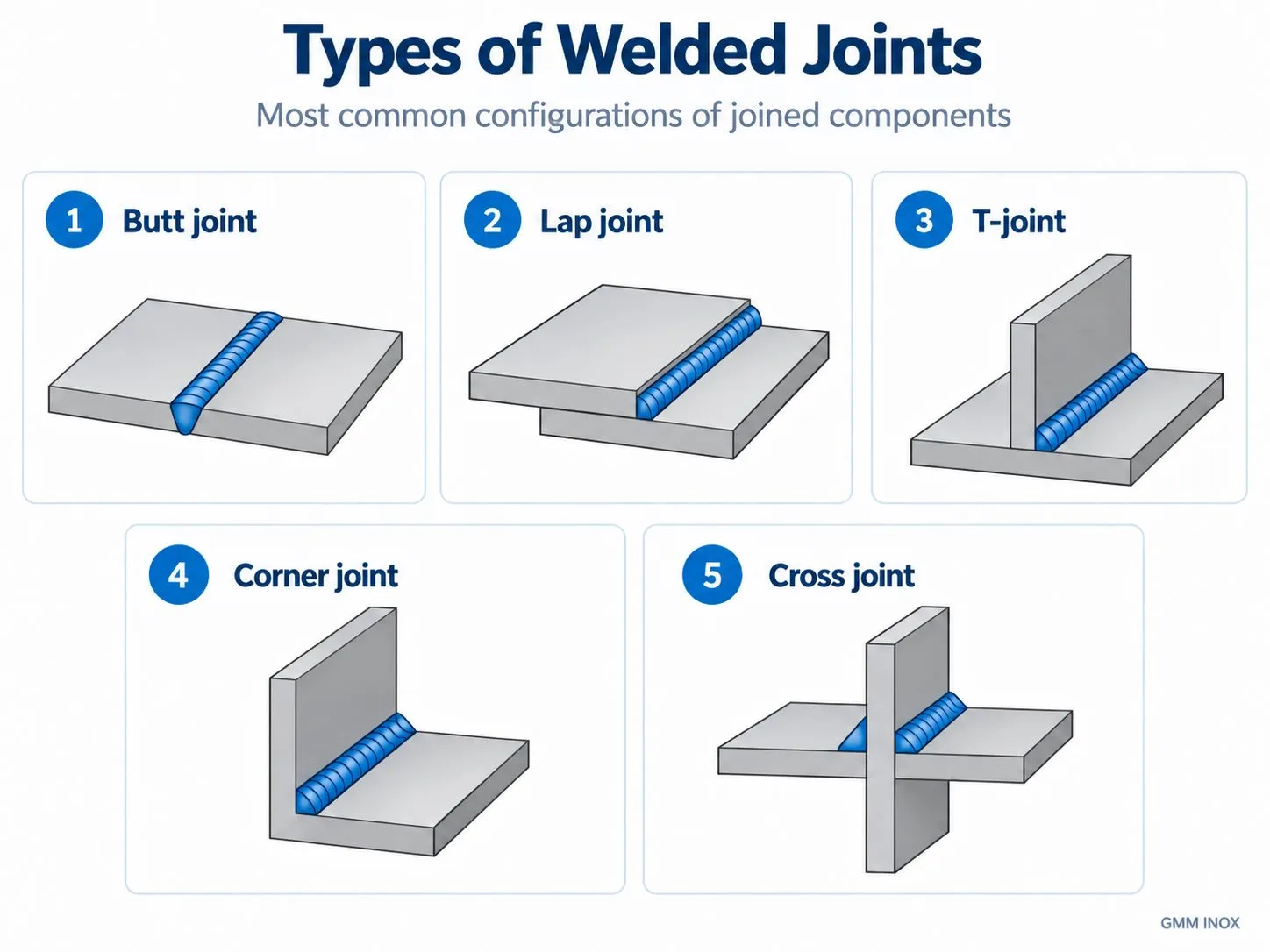
The main types of welded joints
Butt joint
A butt joint is formed when two components are aligned in the same plane and their edges meet.
It is one of the most common joint types used in:
- sheet metal,
- pipes,
- tanks,
- process installations,
- structural components.
Depending on the material thickness, the edges may remain square or be prepared with a groove.
Lap joint
In a lap joint, one component overlaps another.
This arrangement is commonly used for thinner materials and relatively simple structures.
However, in food and pharmaceutical equipment, overlapping surfaces may create crevices that are difficult to clean. For hygienic applications, this must be taken into account during design.
T-joint
A T-joint is created when one component is positioned approximately perpendicular to another, forming a shape similar to the letter T.
These joints are commonly made with fillet welds and are widely used in:
- frames,
- brackets,
- stiffeners,
- steel structures.
Corner joint
A corner joint connects two components at an angle, often 90 degrees.
This type of joint is commonly found in:
- housings,
- tanks,
- box structures,
- fabricated assemblies.
The most common types of welds
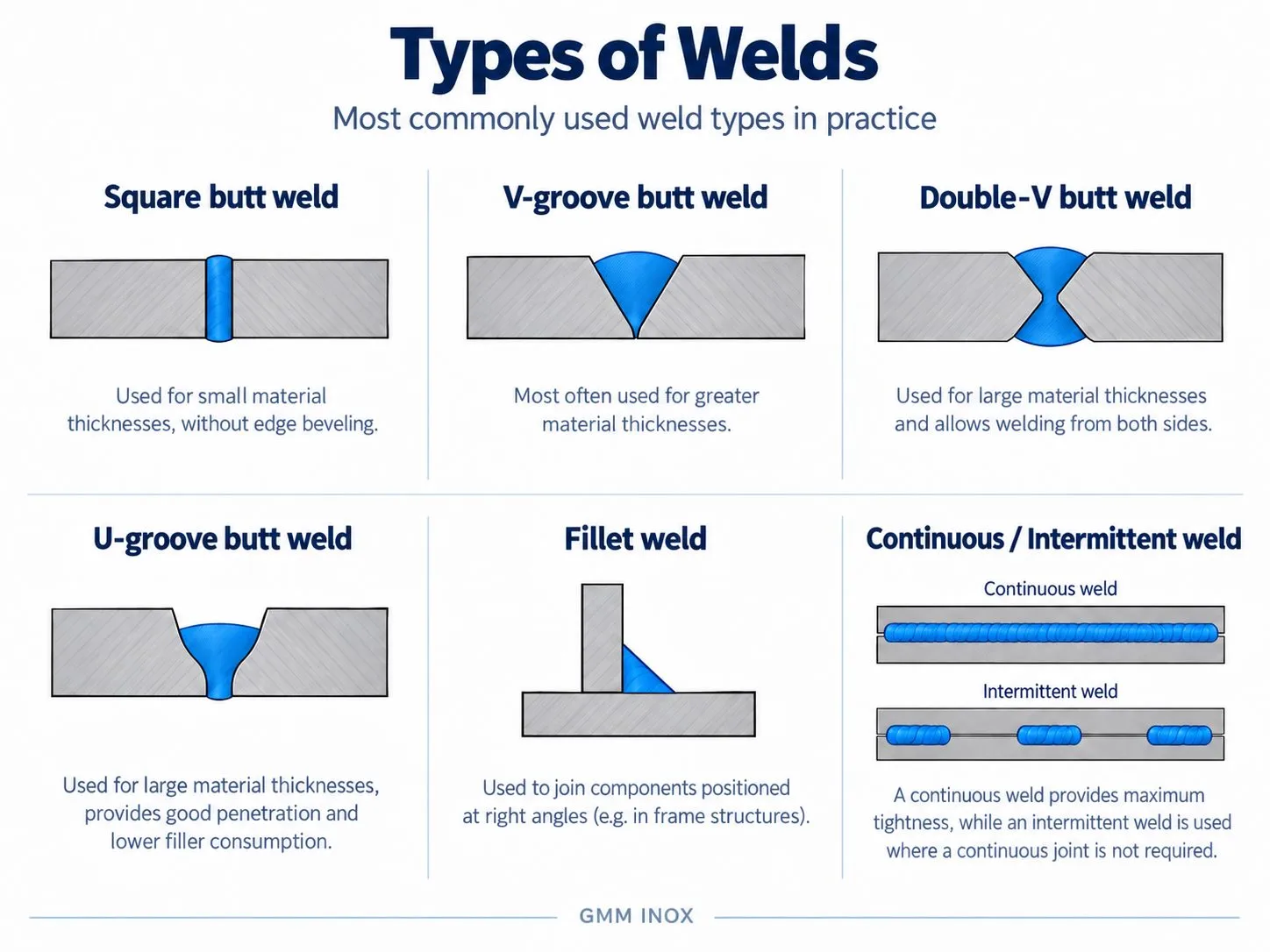
Butt weld
A butt weld is made between the prepared edges of two components.
Depending on the groove preparation, several common variants are used:
- square groove,
- V-groove,
- X-groove or double-V,
- Y-groove,
- U-groove,
- J-groove.
Square groove weld
A square groove weld is made between straight, non-bevelled edges.
It is mainly used on thinner materials where adequate penetration can be achieved without additional edge preparation.
Its advantages include simple preparation and lower filler-metal consumption.
V-groove weld
With a V-groove weld, the edges are bevelled so that they form a V-shaped groove.
This is commonly used on thicker materials where greater access to the joint cross-section is required.
The disadvantage is a larger weld volume compared with a square groove.
Double-V or X-groove weld
A double-V joint is prepared from both sides of the material.
It is often used for thicker sections where access is possible from both sides.
Compared with a deep single-V groove, it can reduce weld volume and help distribute heat more evenly.
U-groove weld
A U-groove uses rounded edge preparation.
It is generally used on thick material because it can reduce the amount of filler metal required.
However, the edge preparation itself is more demanding.
Fillet weld
A fillet weld is one of the most widely used weld types in steel fabrication.
It is most commonly found in:
- T-joints,
- lap joints,
- corner joints.
In cross-section, a fillet weld usually has a roughly triangular shape.
Fillet welds may be:
- continuous,
- intermittent,
- single-sided,
- double-sided.
Continuous and intermittent welds
Continuous weld
A continuous weld runs without interruption along the required length of the joint.
It is used where there is a need for:
- high strength,
- leak-tightness,
- continuous surface integrity.
This is particularly important in tanks and process piping.
Intermittent weld
An intermittent weld consists of separate welded sections with gaps between them.
It can reduce:
- filler-metal consumption,
- welding time,
- heat input,
- distortion.
However, it is not suitable where a fully sealed joint is required.
How is the correct weld type selected?
The type of weld should be determined during the design stage rather than decided only when fabrication begins.
The most important factors include:
Material thickness
Thin material may require relatively simple joint preparation, while thicker sections often require bevelled or machined edges.
Type of loading
A weld may be subjected to:
- tension,
- compression,
- shear,
- bending,
- torsion,
- cyclic loading.
The direction and magnitude of the forces influence joint design.
Access to the joint
If welding is possible from only one side, the joint must be designed accordingly.
If both sides are accessible, alternative preparations such as double-sided grooves may be considered.
Leak-tightness requirements
A process tank or pipeline has different requirements from a machine frame.
For vessels and process systems, leak-tightness is often one of the key design criteria.
Material type
Joint preparation and welding strategy will differ for structural steel, stainless steel and aluminium.
Weld type and welding process
The geometry of a weld and the welding process are separate issues, but they are closely connected.
At GMM INOX, the main processes include:
TIG 141
TIG is widely used for stainless and acid-resistant steels.
It offers precise control of the weld pool and is especially useful where the following are important:
- high weld quality,
- clean appearance,
- controlled heat input,
- pipe welding,
- process equipment fabrication.
MIG/MAG 131/135
MIG/MAG processes offer higher productivity and are commonly used for larger structures and thicker sections.
More information about the available processes can be found on the GMM INOX welding services page.
Weld types in stainless steel fabrication
With stainless steel, weld geometry is especially important because every weld introduces local heat into the material.
This affects:
- the heat-affected zone,
- heat tint,
- residual stresses,
- distortion,
- subsequent surface finishing.
For food and pharmaceutical equipment, the weld must also be suitable for later grinding, polishing and cleaning.
Why weld geometry matters in process tanks
In a standard structural application, load-bearing capacity may be the main requirement.
In a process vessel, the weld may be in direct contact with the product.
This introduces additional requirements, such as:
- leak-tightness,
- smooth transitions,
- absence of crevices,
- cleanability,
- required surface roughness.
A joint design that works well in a steel frame may therefore be unsuitable for a hygienic process vessel.
Weld symbols on technical drawings
Welds are represented using standardised symbols on technical drawings.
These symbols allow designers to define:
- weld type,
- weld size,
- weld length,
- side of the joint,
- finish requirements,
- supplementary instructions.
This enables the welder and welding technologist to interpret the required joint consistently.
Does a larger weld always mean a stronger structure?
No.
A larger weld does not automatically make a joint stronger.
Oversized welds may cause:
- unnecessary filler-metal consumption,
- longer welding times,
- greater heat input,
- higher residual stresses,
- increased distortion.
The weld size should therefore be based on calculations and technical documentation.
Types of welds and welded joints used by GMM INOX
GMM INOX works on projects involving:
- steel structures,
- pipework,
- industrial installations,
- tanks,
- stainless steel equipment,
- machine components.
Different types of welds and welded joints are selected depending on:
- material,
- geometry,
- load conditions,
- leak-tightness requirements,
- required surface finish,
- project documentation.
In stainless steel applications, TIG welding is particularly important where precision and surface quality are critical, while MIG/MAG is also used for larger structures.
More information is available on the GMM INOX welding services page.
Types of welds and welded joints – summary
There is no single best weld type for every application.
A square groove weld may be suitable for thin material, a V- or double-V groove for thicker butt joints, and a fillet weld for T-, lap- or corner joints.
The key is to match:
joint geometry + weld type + welding process + material + service requirements.
That is why welding should be treated as part of the overall manufacturing process rather than as an isolated production step.

