

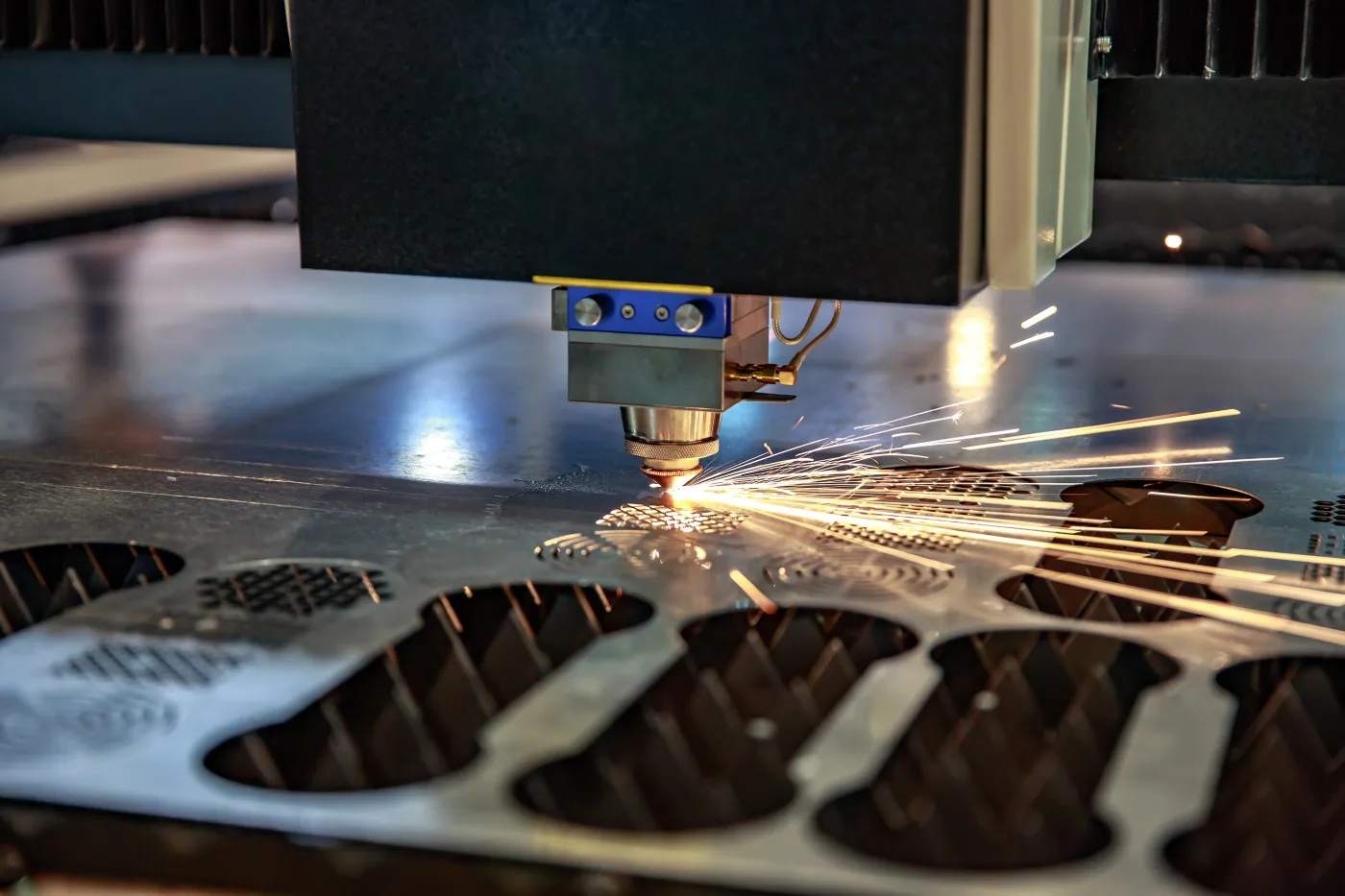


Metal laser cutting is one of the most modern and accurate methods for processing sheet metal and steel components. This technology allows for quick and precise cutting of parts in various shapes while maintaining high repeatability, clean edges, and dimensional accuracy. As a result, it is widely used in industry, machinery manufacturing, construction, and the production of stainless steel, carbon steel, aluminum, and other metals.
In practice, laser cutting relies on using a concentrated beam of high-energy light. The laser beam is directed at the material’s surface, where it causes local heating, melting, or evaporation. The molten material is then removed from the cut kerf using a technical gas. The result is a precisely cut part that can very often go straight to further processing, welding, bending, assembly, or final production.
For industrial companies, laser cutting is especially beneficial when precision, repeatability, and short lead times matter most. It enables the production of both single custom-made parts and entire production runs where every single detail must have the exact same dimensions and shape.
What is metal laser cutting?
Metal laser cutting is the process of separating material using a laser beam. Unlike many traditional processing methods, the laser does not require physical contact between a tool and the material. This means the part is not subjected to the typical mechanical stresses caused by cutting with a saw, shears, or other contact methods.
The laser beam concentrates energy on a very small surface area. This makes it possible to create a narrow kerf, achieve high accuracy, and limit the thermal impact on the rest of the material. It is precisely this tight process control that makes laser cutting so frequently used in the production of technical, structural, and industrial components.
This technology works exceptionally well for both simple shapes and more complex details. The laser can cut holes, corners, arcs, notches, outer contours, mounting elements, machine parts, panels, guards, bases, brackets, and details prepared for further processing.
How does laser cutting work step by step?
The laser cutting process begins with the preparation of a digital design. Most commonly, this is a technical file containing the shape of the component, dimensions, holes, contours, and other details needed to cut the part. Based on this, the operator prepares a program for the CNC machine, which controls the movement of the laser head.
Next, a sheet of metal or another metallic element is placed on the work table. The machine positions the head according to the program, and the laser beam begins cutting. At the point where the laser operates, the material is locally heated to a very high temperature, and a technical gas removes the molten metal from the kerf.
The entire process is computer-controlled, making it possible to maintain high repeatability. If the exact same part needs to be produced multiple times, the machine can reproduce an identical shape with very high precision.
In simple terms, metal laser cutting proceeds through the following stages:
- preparation of documentation or digital design,
- selection of material and sheet thickness,
- preparation of the cutting program,
- setting of laser parameters,
- positioning of the material on the work table,
- execution of the cut,
- inspection of dimensions and edge quality,
- handing over the part for further processing or assembly.
What metals can be laser cut?
Laser cutting is used for many types of metals. In industry, it is most commonly applied to process stainless steel, acid-resistant steel, carbon steel, aluminum, and selected metal alloys.
Stainless steel laser cutting
Stainless steel is one of the most frequently processed materials in industrial plants. It is used where corrosion resistance, aesthetics, hygiene, and durability matter most. Laser cutting of stainless steel makes it possible to obtain highly accurate components that can then be bent, welded, ground, polished, or assembled into larger structures.
Stainless steel components find application in the food, pharmaceutical, chemical, cosmetic, machinery, and technology industries, among others. These can include guards, enclosures, brackets, machine parts, equipment components, structural details, process panels, or production line parts.
Acid-resistant steel laser cutting
Acid-resistant steel is used where the material must withstand a more demanding working environment. It may come into contact with moisture, chemicals, cleaning agents, or process media. Laser cutting allows for the preparation of high-precision details from this material, which can then be used in industrial installations, structures, and equipment.
In the case of acid-resistant steel, edge quality and proper preparation of the component for subsequent production stages are of great importance. Precision cutting can limit the need for additional machining and facilitate subsequent welding or assembly.
Carbon steel laser cutting
Carbon steel, often called mild steel, is widely used in industrial structures, machinery, technical components, frames, bases, brackets, and many other applications. Carbon steel laser cutting allows for the rapid preparation of structural parts with repeatable dimensions.
This solution is particularly useful in serial production and when manufacturing components that must later be welded, bolted, or assembled into larger systems. The laser makes it possible to cut simple and complex shapes without the need for expensive tooling.
Aluminum laser cutting
Aluminum is a lightweight material, resistant to atmospheric corrosion, and frequently used in structures, guards, enclosures, machine details, and technical elements. Aluminum laser cutting requires the proper selection of parameters because this material has different properties than steel.
Precise aluminum machining makes it possible to create lightweight and aesthetic components that can be used in industry, automation, equipment manufacturing, and various auxiliary structures.
What are the biggest advantages of metal laser cutting?
Metal laser cutting is one of the most frequently chosen sheet metal processing methods because it combines accuracy, speed, and production flexibility. Compared to many traditional methods, it delivers better part quality with shorter setup times.
High cutting precision
One of the most important advantages of laser cutting is its very high accuracy. The laser makes it possible to cut components in accordance with technical designs while maintaining dimensional repeatability even across larger production runs. This is of immense importance in industrial manufacturing, where every detail must fit the remaining elements of a structure or device.
Part repeatability
Thanks to CNC control, it is possible to produce many identical parts while maintaining exact dimensions. This is particularly important in serial production, prefabrication of components, and the execution of orders requiring strict compliance with technical documentation.
Aesthetic cutting edge
Laser cutting yields clean and smooth edges. In many cases, this reduces the need for intensive finishing operations. Of course, the final edge quality depends on the material type, thickness, machine parameters, and project requirements, but the laser achieves an excellent result right at the cutting stage.
Ability to cut complex shapes
The laser performs exceptionally well with parts featuring complex geometry. It can cut arcs, holes, notches, non-standard contours, decorative, technical, and mounting elements. As a result, it is utilized both in industrial production and for individual custom projects made to order.
Short lead times
Because the process is based on a digital design, production preparation can be rapid and flexible. There is no need to manufacture special tools for each shape, which shortens implementation time and facilitates the execution of short runs or prototypes.
Reduction of material waste
Cutting software allows for optimized nesting of parts on the sheet metal. This ensures better material utilization and minimizes scrap quantities. This carries both economic and organizational significance, especially with more expensive materials such as stainless or acid-resistant steel.
No mechanical contact between tool and material
During the laser cutting process, the head does not mechanically press against the material like a conventional cutting tool. This minimizes the risk of deformation, scratching, and damage resulting from mechanical contact, which is especially important for thin sheets and components requiring an aesthetic finish.
Laser cutting versus other metal processing methods
Metal cutting can be performed using various methods, including mechanical, plasma, oxy-fuel, waterjet, or laser cutting. Each of these technologies has its applications, but laser cutting is particularly valued where accuracy, repeatability, and edge quality are paramount.
Compared to mechanical cutting, laser cutting offers greater shape freedom and does not require preparing separate tools for each detail. Compared to oxy-fuel or plasma cutting, it typically provides a narrower kerf and greater precision for thin and medium sheet thicknesses. Compared to many manual methods, it ensures significantly better repeatability.
However, this does not mean that the laser is always the only choice. The selection of technology should depend on the material type, thickness, required accuracy, budget, delivery time, and the intended future use of the component. In many projects, however, laser cutting is the most cost-effective and technically sound solution.
What are laser-cut components used for?
Laser-cut components are used across a wide variety of industries. Their greatest advantage is that they can be manufactured precisely according to technical documentation and tailored to specific applications.
Laser cutting is used, among other things, for the production of:
- machine components,
- industrial equipment parts,
- steel structures,
- enclosures and guards,
- technical panels,
- brackets and holders,
- bases and frames,
- mounting elements,
- stainless steel details,
- components for the food industry,
- elements for the pharmaceutical industry,
- details for subsequent welding,
- elements for bending,
- parts manufactured based on technical drawings.
In practice, the laser is often the first stage of a larger manufacturing process. The cut component can then be bent, welded, ground, polished, assembled, or built into an industrial device.
Laser cutting as a production stage for stainless steel components
In companies specializing in stainless steel processing, laser cutting is a crucial stage in production preparation. It allows for the rapid acquisition of precise details that can subsequently be used to build industrial equipment, structures, installations, or components.
In the case of stainless steel, accuracy, edge quality, and maintaining proper aesthetics are particularly important. Stainless steel components often operate in environments where hygiene, ease of cleaning, and corrosion resistance matter most. Therefore, proper material preparation for subsequent processes must be ensured right at the cutting stage.
Laser cutting makes it possible to produce stainless steel details intended for the food, pharmaceutical, chemical, cosmetic, and manufacturing industries, among others. These can include both individual elements and larger sets of parts prepared for subsequent welding or assembly.
What affects laser cutting quality?
The quality of laser cutting depends on many factors. A modern machine alone is not enough. Equally important are the operator’s experience, proper project preparation, parameter selection, and the correct matching of technology to the material.
The most important factors influencing the final result are:
- type of cut metal,
- material thickness,
- quality and condition of the sheet surface,
- laser power,
- cutting speed,
- type of technical gas,
- gas pressure,
- beam focusing,
- condition of the nozzle,
- stability of the work table,
- correctness of the technical file,
- tolerance and edge requirements.
A well-adjusted process makes it possible to obtain a detail compliant with the documentation, featuring an aesthetic edge and dimensions tailored to the next stage of production.
How to prepare a project for laser cutting?
For the laser cutting process to run smoothly, the documentation should be properly prepared. It is best when the client provides a technical file containing the exact shape of the component, dimensions, holes, radii, contours, and material information.
When preparing a project, it is worth paying attention to:
- material type,
- sheet thickness,
- quantity of pieces,
- required tolerances,
- method of further processing,
- bending locations,
- elements intended for welding,
- direction of brushing or surface finish,
- aesthetic requirements,
- intended use of the finished detail.
If the project is to be bent or welded later, it is worth taking this into account already at the stage of preparing the file for cutting. This helps avoid assembly problems, element mismatches, or the need for corrections.
Does laser cutting require further processing?
In many cases, a component can go straight to the next production process after laser cutting. However, everything depends on project requirements. Some details require additional deburring, grinding, beveling, bending, welding, polishing, or surface protection.
Further processing is especially important when the component is to be visible, operate in a hygienic environment, come into contact with a product, or be joined with other elements in a structure. In such cases, not only the dimensions themselves matter, but also the quality of the surface and edges.
Therefore, it is best to treat laser cutting as one of the stages of complete metal processing. A well-cut detail is the foundation, but final product quality is also determined by subsequent processing and assembly.
Metal laser cutting in industrial production
In industrial manufacturing, repeatability, meeting deadlines, and compliance with documentation are what count. Laser cutting responds to these needs very well because it allows for a quick transition from a digital design to a finished detail.
This is particularly important in the production of machinery, stainless steel equipment, industrial structures, process line components, guards, enclosures, and custom-made parts. The laser makes it possible to produce details of various shapes without the need for time-consuming tool preparation.
Thanks to this, the technology proves effective both for prototypes, single elements, and production runs. For the investor, this means greater flexibility and the ability to respond more quickly to production needs.
Laser cutting at GMM INOX
GMM INOX offers sheet metal laser cutting as a precise method for preparing components for further production. This service is especially important when executing projects involving stainless steel, acid-resistant steel, structural steel, and other materials used in industry.
Thanks to laser cutting, it is possible to produce details compliant with technical documentation that can then undergo further processes such as bending, welding, grinding, polishing, or assembly. This is particularly important in projects requiring high accuracy, repeatability, and aesthetic execution.
At GMM INOX, laser cutting is part of a broader production background. The company handles not only the cutting of details itself, but also comprehensive processing and manufacturing of stainless steel elements for industry. As a result, the client can commission the preparation of components tailored to subsequent stages of production or assembly.
When is it worth commissioning metal laser cutting?
Laser cutting is worth choosing when accurate and repeatable metal components are needed. This technology is especially suitable for projects where quality, short lead times, and the ability to manufacture details compliant with documentation matter.
It is worth considering laser cutting if:
- you need precise sheet metal components,
- the part has a complex shape,
- high repeatability is required,
- the components will later be bent or welded,
- you want to reduce material waste,
- you care about an aesthetic edge,
- you manufacture parts for machinery or equipment,
- you need stainless steel components,
- you are executing an industrial project based on technical documentation.
Laser cutting is a great choice both for manufacturing companies and for investors who need custom-made metal components.
Most common mistakes when commissioning laser cutting
To avoid problems, it is worth preparing the order thoroughly. One of the most common mistakes is incomplete documentation. A lack of information regarding the material, thickness, tolerance, or quantity can extend the quotation and execution process.
The second mistake is failing to account for subsequent processing. If a component is to be bent, welded, or assembled in a specific location, this must be considered already at the design stage. This helps avoid collisions, misaligned holes, or assembly issues.
Another problem is selecting a material without analyzing its future application. Different materials work well in technical structures, others in equipment for the food industry, and still others in environments prone to corrosion.
It is also worth remembering that while laser cutting is a highly accurate technology, the final result always depends on file quality, process parameters, and the contractor’s experience.
Laser cutting and production cost optimization
Laser cutting can significantly impact production cost optimization. Through precise nesting of components on the sheet metal, material utilization is improved and scrap is minimized. The speed of the process shortens component preparation times, while repeatability reduces the risk of manufacturing errors.
For industrial companies, it is also important that the laser enables efficient production of elements for subsequent processes. When details are well-cut, they are easier to bend, weld, and assemble, which reduces the number of corrections and shortens overall project lead time.
In practice, savings do not come solely from the cutting itself. The quality of preparing the detail for the next stages of production is what matters most.
Summary
Metal laser cutting is a precise, fast, and repeatable method for processing sheet metal and steel parts. It relies on a concentrated laser beam that locally melts or vaporizes the material, making it possible to achieve exact shapes compliant with digital designs.
This technology works well for processing stainless steel, acid-resistant steel, carbon steel, aluminum, and other metals used in industry. It makes it possible to manufacture machine components, structures, enclosures, guards, brackets, mounting details, and components prepared for further processing.
For manufacturing companies, laser cutting means high accuracy, clean edges, shorter lead times, and the ability to produce both single details and larger runs. At GMM INOX, laser cutting is part of comprehensive metal processing and the manufacturing of stainless steel elements for industry.
If you need precisely cut metal details, stainless steel elements, parts for subsequent welding, or components manufactured based on technical documentation, laser cutting will be one of the best technologies for executing such a project.

