

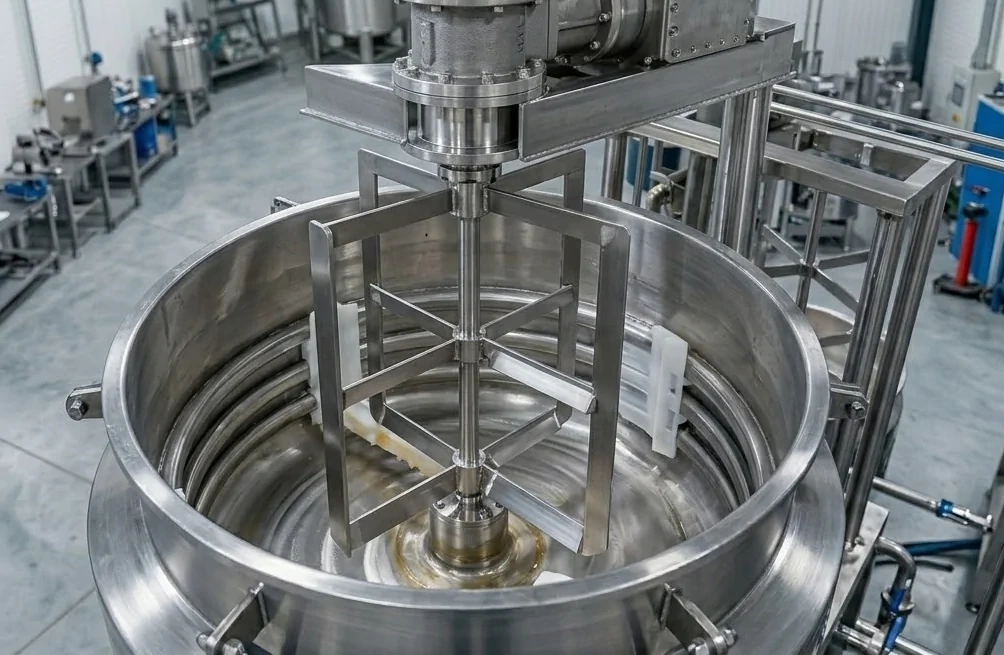


Selecting the right industrial agitator should begin with an assessment of the product and the process requirements, rather than simply choosing a motor size or rotational speed. A low-viscosity liquid requires a very different mixing solution from a thick paste, cream or gel, while a suspension containing solid particles presents another set of challenges altogether.
The purpose of the mixing process is equally important. An agitator may be required to homogenise a product, dissolve ingredients, create an emulsion, keep solids in suspension, maintain an even temperature or gently circulate a shear-sensitive product.
There is therefore no single industrial agitator that is suitable for every application. The design should be matched to the properties of the medium, the geometry of the vessel and the required process outcome.
Where Should You Start When Selecting an Industrial Agitator?
The first step is to define the properties of the product being processed.
The most important parameters include:
- viscosity,
- density,
- operating temperature,
- presence of solid particles,
- sensitivity to shear,
- tendency to foam,
- chemical aggressiveness,
- changes in product properties during processing.
It is equally important to establish exactly what the mixer is expected to achieve.
Typical process objectives include:
- homogenisation,
- dissolving ingredients,
- emulsion preparation,
- dispersion,
- keeping solids in suspension,
- preventing sedimentation,
- temperature equalisation,
- supporting heating or cooling.
Two products with similar viscosities may still require completely different mixing systems if the required process result is different.
Product Viscosity and Agitator Selection
Viscosity is one of the most important parameters when selecting an industrial agitator.
As viscosity increases, the resistance to flow also increases. In highly viscous products, a small impeller may provide intense mixing only in the immediate area around the rotating element, while leaving other areas of the vessel poorly circulated.
Viscosity affects, among other things:
- the type of agitator,
- impeller diameter,
- impeller geometry,
- rotational speed,
- torque requirement,
- required drive power.
Agitators for Low-Viscosity Liquids
For low-viscosity liquids, propeller agitators are often an effective solution.
They generate strong axial flow and can be used for:
- blending liquids,
- dissolving ingredients,
- equalising temperature,
- maintaining a uniform composition.
Their primary role is to move a relatively large volume of liquid efficiently through the vessel and maintain good overall circulation.
Agitators for High-Viscosity Products
Creams, pastes, gels and other viscous products require a different approach.
In these applications, moving a large proportion of the product within the vessel is often more important than achieving very high rotational speed.
Anchor or frame agitators are commonly used for this purpose.
Their working elements have a larger diameter and can operate close to the vessel wall. This can be particularly beneficial in processes where the product is heated or cooled through the vessel jacket.
Types of Industrial Agitators
The most suitable agitator design depends on the characteristics of the medium and the required process result.
Propeller Agitators
Propeller agitators are primarily used for lower-viscosity liquids. They generate strong axial flow and are well suited to applications requiring rapid circulation throughout the vessel.
Typical applications include liquid blending, dissolving ingredients and temperature equalisation.
Turbine Agitators
Turbine agitators are used where more intensive interaction with the product is required.
They may be suitable for:
- homogenisation,
- dispersion,
- emulsion preparation,
- aeration,
- breaking up agglomerates.
Their suitability depends on the formulation and the level of shear required by the process.
Anchor Agitators
Anchor agitators are particularly suitable for high-viscosity products.
The large-diameter working element operates close to the vessel wall, allowing it to move viscous material through a substantial proportion of the vessel volume.
This type of agitator is commonly considered for products such as:
- creams,
- gels,
- pastes,
- thick compounds,
- viscous food products,
- cosmetic formulations.
Frame Agitators
Frame agitators are commonly used in low-speed mixing applications.
They are suitable for viscous products and processes where the product needs to be moved gently without generating excessive shear.
Low-Speed or High-Speed Agitator?
Higher speed does not automatically mean better mixing.
High-speed agitators are typically used where the process requires intensive mixing, dispersion, rapid dissolution of ingredients or homogenisation.
Low-speed agitators, on the other hand, are particularly suitable for viscous products and for processes where a large volume of product needs to be circulated without subjecting it to excessive shear.
In more complex installations, two different agitators may be installed in the same vessel. For example, a slow-speed anchor agitator may circulate the entire batch while a high-speed mixer provides localised high-shear mixing or homogenisation.
Such a configuration should always be based on the actual process requirements rather than used as a default solution.
Vessel Geometry Has a Direct Impact on Agitator Selection
An agitator and the vessel in which it operates should be treated as a single process system.
When designing a mixing system, factors such as the following must be taken into account:
- vessel diameter,
- vessel height,
- working volume,
- bottom geometry,
- minimum and maximum filling levels,
- nozzle positions,
- heating or cooling jacket,
- internal coils or other vessel internals.
The position of the agitator and the relationship between the impeller diameter and vessel dimensions are also important.
An undersized or poorly positioned mixing element can create dead zones, where product circulation is significantly weaker.
This may lead to inconsistent product composition, settling of solids and difficulties in maintaining repeatable batch quality.
Agitator Selection for Heating and Cooling Processes
In many industrial processes, mixing takes place at the same time as heating or cooling.
The agitator should then provide effective circulation between the product near the vessel wall and the material in the centre of the vessel.
This is particularly important with high-viscosity products, where natural convection is limited.
In such applications, appropriate impeller geometry can have a significant effect on temperature uniformity and overall process time.
How to Select the Drive Power for an Industrial Agitator
Motor power should be determined from the requirements of the complete mixing system.
Key factors include:
- product viscosity and density,
- impeller diameter,
- impeller type,
- rotational speed,
- batch volume,
- vessel geometry.
Oversizing the motor may unnecessarily increase both capital and operating costs, while an undersized drive may fail to provide the required process performance.
For this reason, drive power should never be selected independently of the agitator design and product properties.
When Is Variable Speed Control Worth Using?
The properties of a product can change considerably during different stages of the process.
For example, viscosity may increase after another ingredient is added and then decrease again as the product is heated.
Variable speed control allows the agitator to be adjusted to suit changing process conditions.
It can also help reduce energy consumption, as the agitator does not need to operate at maximum speed throughout the entire production cycle.
Why Are Industrial Agitators Made from Stainless Steel?
In many industrial applications, stainless steel agitators are used because of their durability, corrosion resistance and suitability for hygienic processing.
This is particularly important in industries such as:
- food and beverage,
- cosmetics,
- pharmaceuticals,
- chemicals.
Depending on the process, materials such as AISI 304 and AISI 316L stainless steel may be used.
The correct grade should be selected according to the product composition, operating temperature, cleaning chemicals and the chemical environment within the installation.
Hygiene and Cleanability of the Agitator
In food, cosmetic and pharmaceutical production, mixing performance is only one part of the requirement.
The agitator should also be designed to allow effective cleaning.
Important design considerations include:
- appropriate surface finish,
- high-quality welds,
- minimising difficult-to-clean areas,
- suitable seals,
- compatibility with CIP or SIP cleaning systems.
In hygienic applications, the mechanical design must therefore support both effective mixing and reliable cleaning.
Standard Agitator or Custom-Designed Mixing System?
A standard agitator may be sufficient for straightforward applications where the product characteristics and operating conditions are well understood.
A custom-designed solution becomes more important when:
- the product has high viscosity,
- viscosity changes during processing,
- solids are present,
- heating or cooling is required,
- the product is shear-sensitive,
- the vessel has unusual geometry,
- strict hygienic requirements apply,
- the process consists of several distinct stages.
In these situations, the agitator can be engineered around the process rather than forcing the process to work around the limitations of a standard machine.
GMM INOX designs and manufactures industrial mixers and agitators in stainless steel with the mixing system adapted to the properties of the product, vessel parameters and the required process outcome.
What Information Should You Prepare Before Ordering an Industrial Agitator?
Before contacting a manufacturer, it is worth preparing basic information about the product, vessel and process.
The most useful data includes:
- type of product,
- viscosity,
- density,
- operating temperature,
- presence of solid particles,
- vessel capacity,
- vessel diameter and height,
- bottom geometry,
- required mixing result,
- target process time,
- heating or cooling requirements,
- hygienic requirements,
- required construction material,
- preferred mounting arrangement.
The more accurate the process data, the easier it is to engineer a mixing system that performs reliably under real operating conditions.
Common Mistakes When Selecting an Industrial Agitator
One of the most common mistakes is selecting the equipment primarily on the basis of motor power.
A larger motor cannot compensate for incorrect impeller geometry.
Other common mistakes include:
- failing to account for product viscosity,
- ignoring vessel geometry,
- using unnecessarily high rotational speeds,
- failing to consider how the product changes during processing,
- choosing equipment solely on initial purchase price.
In practice, effective mixing depends on matching all elements of the system to the specific process requirements.
How to Choose an Industrial Agitator – Summary
Selecting an industrial agitator requires considering the product, the process and the vessel as one complete system.
The most important factors include:
- viscosity and density,
- purpose of mixing,
- vessel geometry,
- required flow pattern,
- product sensitivity to shear,
- operating temperature,
- agitator type,
- rotational speed,
- construction material,
- hygienic requirements.
Only after these parameters have been assessed can it be determined whether the most suitable solution is a propeller, turbine, anchor or frame agitator, or a custom-engineered mixing system.
For more demanding applications, the agitator should be treated as an integral part of the process installation rather than as an independent component selected solely by motor power or physical dimensions.

