

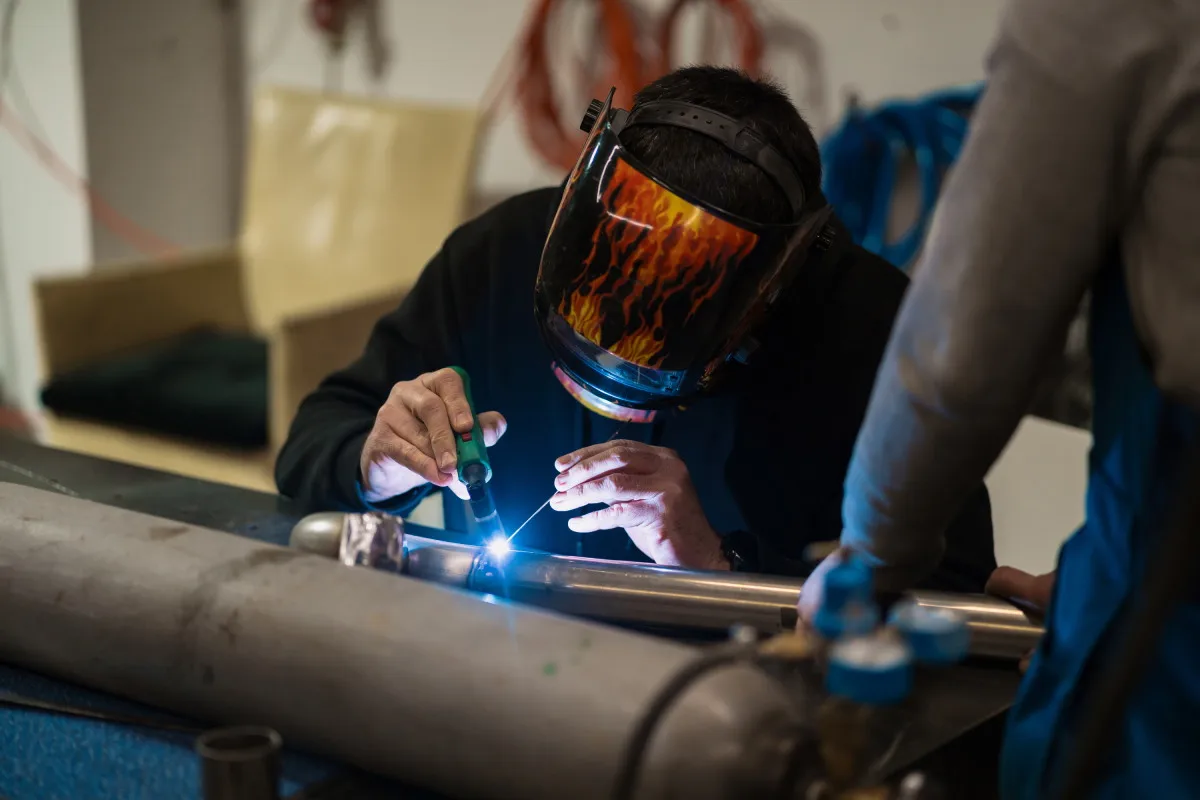


Is welding still a good career choice in Poland in 2027? Looking at both the Polish and wider European labour markets, my answer is: yes – provided that welding is treated as a skilled technical profession requiring continuous development, rather than a quick route to a high salary after a short training course.
There is genuine demand for welders. In both 2025 and 2026, welding remained one of the occupations affected by labour shortages in Poland. At the same time, the gap between an entry-level welder carrying out straightforward MAG work and an experienced TIG specialist working with stainless steel, aluminium or process pipework can be substantial.
This distinction is becoming increasingly important.
In my view, the market value of a welder in 2027 will depend less on simply holding a welding qualification and more on actual capability: the ability to produce consistent weld quality, understand materials, read technical drawings, work in demanding positions and carry out jobs that require a high level of responsibility.
To assess whether welding remains an attractive career, it is therefore worth looking beyond individual job advertisements promising unusually high earnings and analysing what actually happened in 2025 and 2026 – and what these trends may mean for 2027.
The Welding Labour Market in Poland – What Did 2025 Show?
The 2025 labour market confirmed that the shortage of welders in Poland was not merely a claim repeated by training providers or recruitment agencies.
According to Poland’s Occupational Barometer, the situation in 2025 was as follows:
| Local labour market situation | Number of districts in 2025 |
| Severe shortage of welders | 17 |
| Shortage of welders | 280 |
| Balanced supply and demand | 83 |
| Surplus of welders | 0 |
| Significant surplus | 0 |
This means that 297 districts were classified as experiencing either a shortage or severe shortage of welders.
Just as importantly, not a single district was identified as having an oversupply of welders.
This is a strong signal, but it needs to be interpreted carefully.
It does not mean that anyone completing a basic welding course could immediately choose between employers and dictate salary expectations. In many cases, the shortage concerns people with the right qualifications and proven practical ability, rather than simply anyone interested in entering the profession.
That distinction is fundamental when analysing the welding labour market.
Welder Salaries in Poland in 2025
Industry publications reported a very wide range of earnings in 2025.
Spawalnicze24 indicated typical net monthly earnings of approximately PLN 4,000–8,000 depending on experience, specialisation and region. Other market analyses placed the median gross salary at roughly PLN 6,700, with a significant proportion of welders earning within the PLN 5,800–7,900 gross range.
These figures should not be treated as one official salary benchmark for the profession, because they come from different methodologies and datasets.
They do, however, demonstrate something important:
there is no single “welder’s salary”.
A production welder carrying out repetitive MAG welds, a TIG welder working with stainless steel, an aluminium specialist and a pipe welder producing joints subject to demanding inspection requirements all operate in very different parts of the labour market.
What Changed in the Polish Welding Market in 2026?
The 2026 figures are particularly interesting because they indicate some normalisation – but not a reversal of the wider trend.
According to the Occupational Barometer:
| Local labour market situation | 2025 | 2026 |
| Severe shortage | 17 | 18 |
| Shortage | 280 | 256 |
| Balanced market | 83 | 106 |
| Surplus | 0 | 0 |
| Significant surplus | 0 | 0 |
The number of districts classified as having either a shortage or severe shortage therefore decreased from 297 in 2025 to 274 in 2026.
At the same time, the number of balanced local labour markets increased from 83 to 106.
This is one of the most important observations in the entire analysis.
Poland is not experiencing an endlessly worsening shortage of welders in every region.
The situation is more nuanced. In some local markets, the relationship between employer demand and available workers has improved.
However, there was still not a single district classified as having a surplus of welders.
The more accurate conclusion is therefore that demand remains structurally strong, while the intensity of that demand varies by region and by level of specialisation.
How Much Does a Welder Earn in Poland in 2026?
Market analysis published in 2026 places the median welder salary at approximately PLN 7,290 gross per month, with common full-time salary ranges of roughly PLN 6,500–11,000 gross.
There are, however, significant differences depending on the welding process and level of experience.
| Specialisation | Approximate market salary in 2026 |
| MAG – entry level | PLN 6,000–7,500 gross |
| MAG – experienced | PLN 7,000–9,000 gross |
| MAG – senior | PLN 9,000–11,000 gross |
| MIG – experienced | PLN 8,000–12,000 gross |
| MIG – aluminium | PLN 10,000–14,000 gross |
| TIG – junior | PLN 7,000–9,000 gross |
| TIG – stainless steel | PLN 8,000–12,000 gross |
| TIG – pipework, energy, chemical sector | PLN 10,000–14,000 gross |
| TIG – highly experienced and qualified | PLN 12,000–18,000 gross |
These are market estimates rather than official government salary bands and should therefore be treated as indicative rather than guaranteed.
They nevertheless show clearly how strongly welding income depends on specialisation.
Do Welders Really Earn More Than the Polish Average?
This is where one of the most common assumptions about welding needs to be challenged.
In June 2026, the average monthly salary in Poland’s enterprise sector exceeded PLN 9,300 gross.
If we compare that with an estimated median welder salary of around PLN 7,290 gross, it would be misleading to say that every welder earns above the national average.
The reality is more complicated.
Entry-level welders and workers carrying out less demanding production tasks may earn below the enterprise-sector average.
Experienced specialists – particularly TIG welders, aluminium welders, pipe welders and those working on high-specification industrial projects – can earn considerably more.
The key question is therefore not simply:
How much does a welder earn?
It is:
What type of welding can the person perform, on which materials, to what quality standard and with what level of responsibility?
What Really Determines a Welder’s Salary?
One of the biggest mistakes when analysing welding salaries is treating “welder” as a single uniform occupation.
The labour market does not pay a premium merely because someone holds a welding certificate.
Pay is strongly influenced by what a person can actually do.
The most important factors include:
- welding process,
- material being welded,
- welding positions,
- type and complexity of joints,
- practical experience,
- consistency and quality of welds,
- ability to read engineering drawings,
- knowledge of welding documentation,
- qualifications for specific applications,
- industry,
- willingness to work on demanding or specialised projects.
The highest market value tends to be associated with skills that cannot easily be replaced by a worker after basic training.
MAG, MIG or TIG – Which Offers the Best Career Prospects?
MAG – a Strong Entry Route into Welding
MAG remains one of the most widely used welding processes in steel fabrication and industrial manufacturing.
It provides a broad range of employment opportunities and can be an excellent starting point for someone entering the profession.
However, simple and highly repetitive MAG operations are also among the areas most exposed to automation.
This does not mean MAG welders will no longer be needed.
It means that workers able to weld more complex structures, operate in multiple positions, interpret technical requirements and maintain consistently high quality will be significantly more valuable.
MIG – Aluminium Adds Valuable Specialisation
The ability to weld aluminium and other non-ferrous metals opens access to more specialised manufacturing sectors.
Market data from 2026 suggests that experienced aluminium welders can command higher salaries than workers performing basic MAG welding.
This reflects the greater technical demands of the work and the smaller pool of experienced specialists.
TIG – Strong Potential for Specialist Careers
TIG remains one of the most attractive routes for people aiming to specialise in precision welding of stainless steel, aluminium and process pipework.
The process requires excellent control and a high level of technique.
As a result, the difference between a newly trained TIG welder and an experienced specialist can be substantial.
The strongest earning potential is generally found in areas such as:
- stainless steel fabrication,
- sanitary installations,
- food-processing equipment,
- pharmaceutical installations,
- process pipework,
- pressure equipment,
- energy and chemical projects.
At GMM INOX, for example, specialist welding services form part of the manufacture of stainless steel process equipment for demanding industrial applications, where weld quality, repeatability and material knowledge are critical.
What Qualifications Does a Welder Need?
Completing a welding course should not be confused with being qualified for every type of welding work.
The required scope of qualification depends on factors such as:
- welding process,
- parent material,
- type of joint,
- material thickness,
- pipe diameter,
- welding position.
In Poland, welder qualification examinations are carried out according to recognised standards, including the PN-EN ISO 9606 series for different material groups.
For someone planning a long-term welding career, the best approach is therefore progressive development.
The aim should not be to collect as many certificates as possible.
Qualifications should support the type of work the individual actually wants to perform.
A structural steel welder requires a different skill set from someone welding stainless steel equipment for the food or pharmaceutical sector, and both differ again from a specialist producing pressure pipework.
Is Welding a Good Career Without a University Degree?
Yes.
This remains one of the major advantages of welding as a career.
It is possible to enter the profession relatively quickly and then build market value through practical experience, further training and additional qualifications.
That does not make welding an easy profession.
A good welder needs more than the ability to operate a welding machine.
They should understand:
- material behaviour,
- joint preparation,
- the effect of welding parameters,
- distortion,
- heat input,
- technical documentation,
- quality requirements,
- the consequences of weld defects.
The more demanding the product, the less important pure welding speed becomes and the more important repeatability, technical understanding and quality are.
Poland Compared with Europe – Is Working Abroad Still Worth It?
Poland is not unique in facing shortages of skilled technical workers.
Labour market data from EURES shows shortages of welders and related metalworking occupations across a number of European countries.
This includes major industrial markets such as Germany as well as parts of Scandinavia, the Netherlands and other Western European economies.
The result is that Polish welders are not competing only within the Polish labour market.
A highly skilled welder can potentially access employment opportunities across much of Europe.
How Much Can Welders Earn Abroad?
In 2026, published job examples included monthly net earnings of approximately:
- EUR 2,000 in some German positions,
- up to around EUR 3,000 for MAG welding work in Germany,
- approximately EUR 3,300 in Denmark,
- up to around EUR 3,500 in selected contracts with accommodation included.
These figures should be compared carefully.
A salary of EUR 3,000 net in one country is not automatically financially superior to a good specialist salary in Poland.
The comparison should include:
- accommodation costs,
- transport,
- local cost of living,
- overtime,
- number of working hours,
- shift patterns,
- travel home,
- tax arrangements,
- whether accommodation is provided.
The correct comparison is therefore disposable income and quality of life, not simply the headline figure on a job advertisement.
Are Polish Welders Still Competitive in Europe?
In my view, yes – particularly when they combine recognised qualifications with genuine experience and the ability to work to demanding quality standards.
The European shortage of skilled technical labour also creates another important effect.
Polish manufacturers are no longer competing for workers only with the factory located in the next town.
They are indirectly competing with employers in Germany, the Netherlands, Belgium, Denmark and Scandinavia.
This increases pressure on Polish companies to offer competitive working conditions and pay to retain their best specialists.
Will Welding Robots Replace Human Welders?
Automation will be one of the most important forces changing the profession, but I do not expect it to eliminate demand for welders by 2027.
Robotic welding works particularly well where production is:
- high-volume,
- repetitive,
- standardised,
- dimensionally consistent,
- carried out under stable conditions.
Human welders remain significantly more difficult to replace in:
- one-off fabrication,
- prototypes,
- repairs,
- site installation,
- restricted access work,
- complex assemblies,
- variable production,
- work requiring constant adjustment.
The profession will therefore change rather than disappear.
The greater long-term risk for a welder is not the existence of a welding robot.
It is failing to develop skills while technology and production standards move forward.
Which Welders Are Likely to Be Most In Demand in 2027?
I expect the labour market to distinguish increasingly strongly between basic welding capability and specialist competence.
Simple repetitive operations will continue to become easier to automate.
At the same time, experienced specialists will remain difficult to replace.
The strongest position is likely to belong to welders combining several capabilities, for example:
- strong practical welding skills,
- TIG expertise,
- stainless steel experience,
- aluminium welding,
- pipe welding,
- multiple welding positions,
- technical drawing interpretation,
- knowledge of welding procedures,
- experience in regulated or high-quality industries.
The value of a welder will therefore increasingly depend not on the job title itself but on the answer to a much more specific question:
What can you weld, using which process, on which materials and to what quality level?
Outlook for 2027 – Will Demand for Welders Remain High?
As of August 2026, Poland’s official Occupational Barometer provides forecasts for 2026. A complete official 2027 forecast is not yet available.
Any discussion of 2027 should therefore be treated as an evidence-based scenario rather than confirmed statistical data.
My base-case expectation is that Poland will continue to experience a shortage of welders in 2027, although some local labour markets may continue moving towards equilibrium.
There are several reasons for this.
First, despite the improvement between 2025 and 2026, 274 districts were still classified as experiencing a shortage or severe shortage of welders in 2026.
There were no districts with an oversupply.
Second, shortages of skilled technical workers remain a wider European problem rather than a purely Polish one.
Third, the medium-term economic outlook continues to assume economic growth and industrial investment, which should support demand for technical trades.
The key change, however, is likely to be greater differentiation within the profession.
Demand for a basic welder and demand for an experienced specialist should increasingly be treated as two separate labour-market questions.
How Much Could a Welder Earn in Poland in 2027?
This is where it is particularly important to distinguish between current data and forecasts.
In 2026, commonly quoted salary ranges for full-time welding jobs are approximately PLN 6,500–11,000 gross per month, with considerably higher earning potential for specialist TIG and pipe welding roles.
For 2027, I would expect continued moderate wage growth rather than a sudden market-wide jump.
However, the gap between entry-level workers and highly skilled specialists is likely to continue widening.
Workers carrying out basic production welding may experience salary growth broadly in line with the wider manufacturing labour market.
Highly skilled TIG welders, pipe welders, aluminium specialists and welders working with stainless steel on high-specification projects may retain considerably more negotiating power.
That is where I expect the strongest wage pressure to remain.
Is It Worth Taking a Welding Course in 2026 or 2027?
If the decision is based on the belief that one short course will automatically result in a salary of PLN 15,000 or more per month, then no.
That expectation is unrealistic.
If, however, the course is treated as the first stage of building a specialist technical career, it can be a very good investment.
The typical route is:
training → entry-level work → practical experience → further qualifications → more demanding projects → specialisation.
The key point is that welding offers a relatively transparent relationship between capability and market value.
A person who develops genuinely difficult-to-replace skills can significantly improve both salary and job mobility.
Advantages and Disadvantages of Welding as a Career
Welding offers several clear advantages.
It provides a relatively fast route into skilled employment without requiring a university degree. It offers strong geographical mobility, access to international labour markets and a clear opportunity to increase earnings through specialisation.
It is equally important not to idealise the profession.
Welding can involve:
- demanding physical conditions,
- working in uncomfortable positions,
- heat,
- noise,
- shift work,
- industrial environments,
- strict quality requirements,
- significant responsibility.
It requires concentration and discipline.
The correct career question is therefore not simply:
How much can I earn as a welder?
It is also:
Does this type of work suit me, and am I prepared to keep developing technically over the coming years?
2025, 2026 and 2027 – How Is the Welding Market Changing?
Looking at the three-year period, I see evolution rather than revolution.
2025 confirmed a widespread labour shortage, with 297 Polish districts classified as having a shortage or severe shortage of welders.
2026 brought some normalisation. The figure fell to 274 districts, while more local markets moved into balance. Crucially, however, no district recorded an oversupply of welders.
2027, in my view, should continue to offer good opportunities, but employers will increasingly reward specialist competence rather than basic certification alone.
The strongest career prospects should therefore belong to people who keep moving beyond entry-level skills.
Is Welding Worth Choosing as a Career in 2027? My Assessment
Yes. I believe welding will remain one of the more attractive technical career paths in Poland in 2027 for people who want to enter skilled employment relatively quickly and build their professional value through practical ability.
I would not, however, describe welding as an easy route to high earnings.
The most valuable employees will not simply be “people with a welding course”.
They will be specialists who can demonstrate both formal qualifications and, more importantly, consistently high-quality work.
For someone starting today, a sensible path is to develop strong fundamentals, join a company where there is genuine scope to learn, and then gradually move towards more demanding processes, materials and industries.
The Polish labour market in 2025 and 2026 shows that demand for welders is real.
The wider European market shows that these skills can also provide international mobility.
The greatest advantage of becoming a welder in 2027 is therefore not a guaranteed high salary from day one. It is the opportunity to develop a technical skill set that remains valuable in Poland and across many European labour markets.
Łukasz Pawłucki
President of the Management Board
GMM INOX Sp. z o.o.
This analysis is based on labour-market information available as of August 2026, including the Polish Occupational Barometer, national wage data, European labour-market information and specialist welding-industry publications. Statements concerning 2027 represent the author’s market assessment based on currently available data rather than an official salary or employment forecast.

