

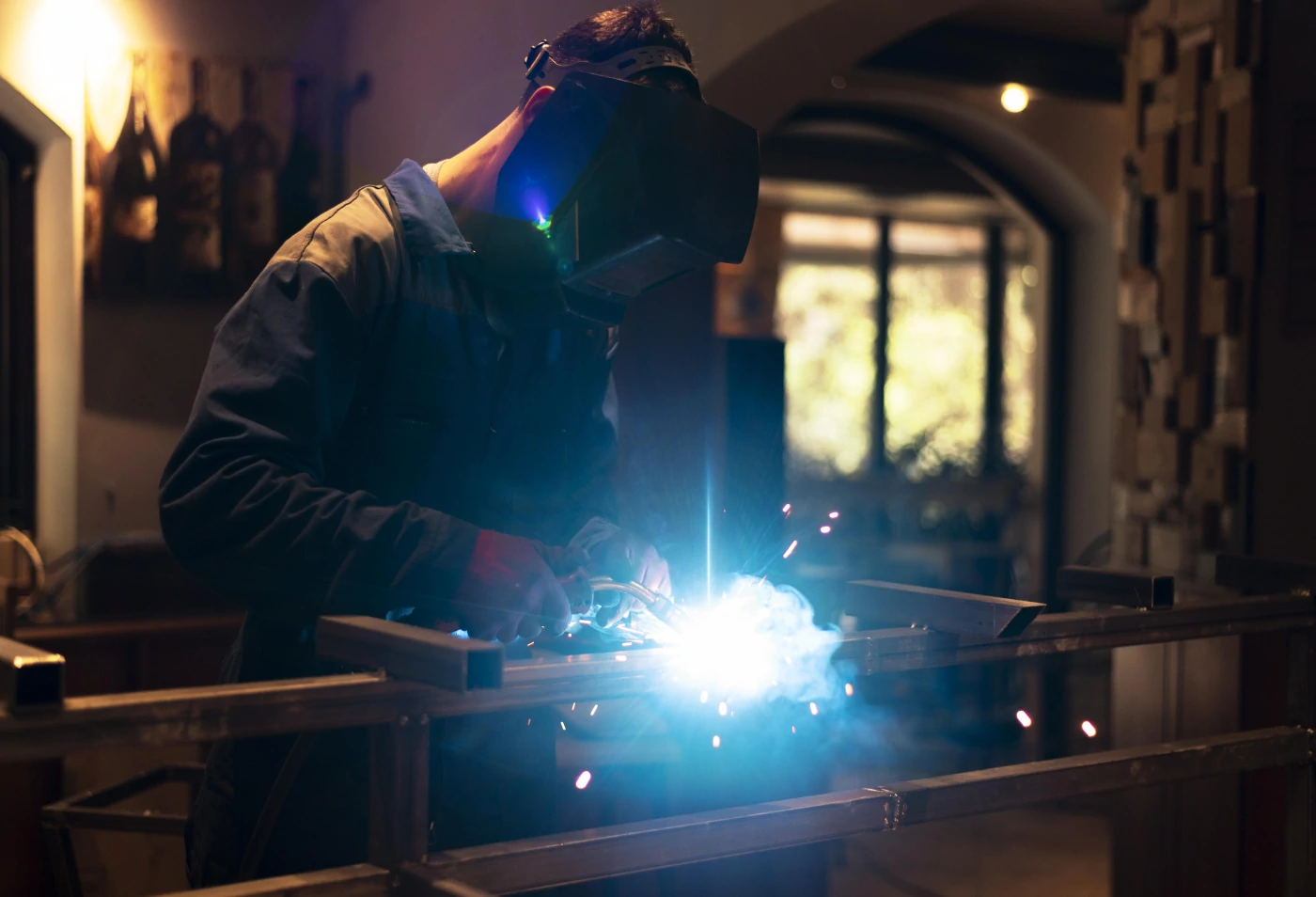


The food and pharmaceutical industries are among the most demanding sectors when it comes to the quality and execution of stainless steel components. Key priorities extend beyond structural integrity to encompass stringent hygienic standards, corrosion resistance, cleanability (CIP suitability), weld repeatability, and absolute compliance with engineering specifications. Every custom component integrated into a production line, process vessel, storage tank, utility piping system, or skid assembly must be manufactured to predictable standards ensuring total process safety during subsequent operations.
One of the core methodologies deployed in fabricating heavy-duty industrial components is MAG welding. This technology is highly valued for its high deposition rates, arc stability, and capability to join heavy-gauge sections. However, within the context of sanitary and sterile processing sectors, it is crucial to clearly delineate where MAG welding delivers optimal performance and where alternative methods—such as TIG welding—are non-negotiable. GMM INOX delivers comprehensive TIG and MIG/MAG welding services, specializing in the precision fabrication of stainless steel and acid-resistant alloy structures tailored to individual customer specifications for high-purity industries.
What is MAG Welding?
MAG welding (Metal Active Gas) is an electric arc welding process utilizing a reactive shielding gas. Under international welding process classifications, MAG is designated as ISO Process 135, whereas MIG is designated as ISO Process 131. The technical distinction between MIG and MAG lies entirely in the shielding gas composition: MAG utilizes an active gas mixture that interacts chemically with the weld pool chemistry under the arc, whereas MIG utilizes strictly inert gases.
In heavy fabrication, MAG welding enables rapid, high-efficiency joint completion, particularly on structural frameworks, technical skids, subframes, brackets, enclosures, and thick-walled profiles. GMM INOX utilizes advanced MIG/MAG technologies to ensure rapid turnarounds and robust mechanical performance on large-scale steel structures and heavy-gauge components.
Within food processing and pharmaceutical manufacturing plants, MAG welding is primarily utilized for fabricating:
- structural support frameworks,
- process equipment skids,
- mezzanines, platforms, and load-bearing structures,
- technical control enclosures,
- machinery guarding and shrouds,
- mounting hardware and fixtures,
- utility and pipe support brackets,
- auxiliary equipment components,
- non-product contact steel fabrications operating outside the hygienic perimeter.
Wherever a weld seam comes into direct contact with food products, active pharmaceutical ingredients (APIs), process media, or aggressive CIP (Clean-in-Place) chemicals, the selection of the welding process must be preceded by a rigorous engineering audit of hygienic, qualitative, and operational requirements.
MAG Welding vs. Sanitary & Sterile Processing Standards
In the food and pharmaceutical sectors, achieving a mechanically sound joint is only half the battle. The weld bead profile must be deposited such that it eliminates any micro-crevices or surface irregularities that could harbor product residues, moisture, or microbial biofilms. This requirement is absolute for all product-contact surfaces and components exposed to intensive washdown and sanitization cycles.
The European Hygienic Engineering & Design Group (EHEDG) emphasizes the critical importance of hygienic stainless steel welding in food manufacturing, specifying strict criteria for weld bead geometry, non-destructive testing (NDT), and validation. Dedicated EHEDG guidelines for hygienic stainless steel applications outline the specific fabrication techniques required to achieve fully sweep-cleanable, crevice-free welds in thin-walled sanitary components.
Consequently, engineering designs for food and pharma applications must clearly distinguish between two distinct zones:
- hygienic components, meaning those that come into direct contact with the product or process media,
- technical and structural components, which perform load-bearing, protective, mounting, or auxiliary functions.
In the first scenario, weld quality requirements are typically highly stringent. In the second scenario, MAG welding serves as a highly practical solution, particularly where durability, throughput, and the ability to join larger-gauge sections are paramount.
Where Does MAG Welding Excel in the Food Industry?
Within the food processing sector, stainless steel is universally utilized for fabricating machinery, structures, and technological installations. This material is highly valued for its superior corrosion resistance, longevity, and ease of surface sanitization. GMM INOX manufactures dedicated stainless steel equipment for both the food and pharmaceutical industries, blending engineering expertise with advanced fabrication technologies.
MAG welding is deployed in the food industry primarily for components that do not demand the highest class of sanitary surface finish on the product-contact side, but must remain durable and resistant to rigorous industrial operations.
Typical applications include:
- subframes and bases for production machinery,
- structural supports for process vessels and equipment,
- process piping overhead supports and hangers,
- machine housings and enclosures,
- safety guarding and barriers,
- load-bearing structures for processing lines,
- auxiliary facility structures,
- maintenance platforms, catwalks, and service steps,
- structural steel elements operating within the production environment.
In these fabrications, the core emphasis is placed on joint integrity, proper base material selection, surface post-treatment (passivation), distortion management, and matching the custom design to the specific operational environment of the plant.
Where Does MAG Welding Excel in the Pharmaceutical Industry?
The pharmaceutical industry imposes uniquely high benchmarks regarding cleanliness, process repeatability, and manufacturing traceability. This applies both to core process machinery and the surrounding technical infrastructure. GMM INOX specializes in executing high-end stainless steel solutions for the pharmaceutical and food sectors, offering certified welding services for the most demanding industrial applications.
In pharmaceutical plants, the MAG method finds its application primarily across structural and technical components, such as:
- heavy load-bearing support frameworks,
- equipment subframes and skids,
- technological mounting racks,
- hardware fixtures and mounting brackets,
- utility service enclosures,
- protective guarding and shrouds,
- auxiliary cleanroom-adjacent structures,
- plant facility infrastructure elements.
For components that come into direct contact with active substances, pharmaceutical-grade water, or ultra-pure process media, a more precise welding technology coupled with ultra-smooth surface finishes (low Ra roughness values) is mandatory. Therefore, the decision to deploy MAG, TIG, or a combined welding procedure specification (WPS) must stem directly from technical documentation, QA/QC requirements, and the distinct operating parameters of the component.
MAG vs. TIG – Which Method to Choose?
In engineering projects for the food and pharmaceutical sectors, the dilemma between choosing MAG welding or TIG welding is highly common. There is no singular, universal answer, as each method is engineered to serve different operational purposes.
The TIG method ensures exceptionally high quality and weld aesthetics, particularly when welding stainless steel and acid-resistant alloys. GMM INOX highlights TIG as the primary method deployed for high-specification stainless and acid-resistant alloys, while positioning MIG/MAG as a high-efficiency technology optimized for heavy structural steel frameworks and larger cross-sections.
In simple terms:
TIG Welding is the preferred process when:
- pristine cosmetic appearance and smooth weld profiles are critical,
- the component features thin-walled sheets or tubes,
- the weld joint is located within a strict hygienic boundary,
- the surface comes into direct contact with the product stream,
- stringent quality control and non-destructive testing are mandated,
- precision and metallurgical purity are top priorities.
MAG Welding is the preferred process when:
- the component features a larger or heavier cross-section,
- maximizing deposition rates and process efficiency is critical,
- fabricating heavy structural frameworks or load-bearing skeletons,
- the weldment operates completely outside the product-contact zone,
- mechanical durability and rapid project lead times are prioritized,
- assembling frames, support brackets, enclosures, or auxiliary infrastructure.
In industrial practice, many complex configurations require a hybrid execution combining multiple technologies. Certain elements can be welded using the TIG process, while others are joined via MAG. This custom approach allows the joining technology to be perfectly matched to the specific function of each individual component, rather than applying a single uniform method across the entire project.
GMM INOX provides fully certified, in-house TIG and MAG welding services, ensuring the joining method is optimally selected based on the specific material grade, part geometry, and engineering requirements of each custom project.
Key Technical Requirements for MAG Welding in Sanitary Environments
1. Metallurgical & Base Metal Selection
Success begins with specifying the correct grade of stainless steel or acid-resistant alloy. The food and pharmaceutical sectors heavily utilize high-alloy, corrosion-resistant steels engineered to withstand humid operating environments, aggressive CIP chemicals, and frequent washdown cycles. GMM INOX fabricates elements and structures exclusively from premier-grade stainless steels and corrosion-resistant alloys specified for demanding hygienic processes.
Material specifications must account for:
- the ambient operating environment,
- exposure to high-velocity water, live steam, or aggressive chemical cleaning matrices,
- thermal cycling and process temperatures,
- regulatory sanitary compliance standards,
- cleaning methodologies (COP vs. CIP suitability),
- specific localized corrosion risks (pitting, crevice corrosion),
- static and dynamic mechanical loads,
- post-weld surface treatments and texturing.
In many custom fabrications, it is also vital to clearly define whether the component will operate in direct contact with the product stream or exclusively as an auxiliary support structure.
2. Weld Joint Preparation and Surface Cleanliness
Welding stainless steel requires immaculate joint preparation. The base metal must be thoroughly degreased, decontaminated, and completely free of any surface impurities that could induce weld defects or cause carbide precipitation. In high-purity sectors, this step is paramount; any surface contamination drastically degrades local corrosion resistance and mechanical toughness.
Prior to welding, meticulous attention must be paid to:
- the absolute removal of grease, oils, and surface residues,
- immaculate joint face cleanliness,
- precise component fit-up and alignment,
- rigid and stable workholding or fixturing,
- zero cross-contamination from carbon steel particulate on the stainless surfaces,
- proper edge preparation and beveling for heavy-gauge sections.
When fabricating stainless steel components, it is critical to strictly isolate production and avoid any contact with tooling previously used on carbon steel. Failure to do so induces localized cross-contamination, disrupting the passive layer and leading to premature pitting or galvanic corrosion.
3. Shielding Gas Selection and Welding Parameters
Because the MAG method utilizes a reactive shielding gas, the specific gas chemistry directly influences arc stability, depth of penetration, weld spatter levels, bead profile geometry, and the final metallurgical integrity of the joint. Equally critical is the precise calibration of welding parameters, including current (amperage), voltage, wire feed speed, and travel speed.
Suboptimal parameter selection can lead to severe weld discontinuities, such as:
- weld porosity and gas entrapment,
- excessive weld spatter,
- lack of fusion or incomplete penetration,
- undercutting along the weld toes,
- excessive heat input and overheating of the alloy,
- severe component warping or thermal distortion,
- degradation of the material’s inherent corrosion resistance,
- increased difficulty during subsequent post-weld surface finishing.
In the food and pharmaceutical sectors, process repeatability is paramount. Every weld seam must not only deliver robust mechanical performance but must also be highly predictable and execute in strict compliance with the verified Welding Procedure Specification (WPS).
4. Distortion Management and Thermal Control
During arc welding, localized thermal expansion and contraction occur, which can induce physical distortion. In industrial frameworks, skids, enclosures, and mounting hardware, even minor dimensional warping can cause severe misalignment during final installation or integration with auxiliary sub-assemblies.
To mitigate the risk of thermal deformation, fabricators must implement:
- an optimized welding sequence and balanced deposition,
- rigid jigging and clamping fixtures,
- strict control and monitoring of localized heat input,
- accurate tack-welding intervals prior to final joint execution,
- continuous dimensional inspection post-welding,
- highly skilled welders certified specifically in stainless steel fabrication.
For complex, large-scale technical structures, a proactive engineering audit of the technical documentation and a detailed manufacturing sequence blueprint are highly recommended.
5. Weld Quality and Geometric Profile
Weld seams deployed in sanitary environments must never create areas that are difficult to clean. This is particularly vital in zones prone to harboring moisture, ambient dust, product residues, or stagnant cleaning solutions. EHEDG continually stresses the importance of hygienic design principles during the execution of stainless steel welded joints, emphasizing that these systems must be accessible for non-destructive inspection and routine verification.
In practice, fabricators must strictly eliminate:
- crevices and micro-fissures,
- undercuts and overlapping profiles,
- surface pores,
- sharp edges or abrupt geometric transitions,
- surface irregularities and ripples,
- liquid entrapment points,
- excessive weld spatter adherence,
- irregular weld beads that impede smooth fluid dynamics during washdowns.
For custom components subject to stringent sanitary requirements, the weld seam itself often mandates advanced secondary post-treatment, such as precision grinding, mechanical polishing, chemical pickling, or passivation. The exact scope of surface conditioning must stem directly from the engineering documentation and client specifications.
6. Post-Weld Corrosion Resistance
Stainless steel owes its exceptional corrosion resistance to a microscopic chromium oxide passive film. The intense thermal cycle of welding—especially under uncalibrated parameters or improper joint preparation—can deplete local chromium content, leaving the Heat-Affected Zone (HAZ) highly vulnerable.
Consequently, post-weld quality control must rigorously address:
- heat tint and oxide discoloration scales,
- surface chemical impurities,
- weld spatter residues,
- surface mechanical micro-scratches,
- the non-negotiable need for thorough weld cleaning,
- full chemical surface passivation treatments,
- strict protection against carbon steel tool cross-contamination.
This protocol is essential in both the food and pharmaceutical sectors, where equipment is subjected to continuous exposure to aggressive chemical sanitizers, humidity, live steam, and corrosive processing agents.
Integrating MAG Welding into Structural Design for Food & Pharma Facilities
In high-purity industrial engineering, welding must never be treated as an isolated fabrication task detached from overall structural planning. Right from the initial design phase, engineers must fully account for weld joint configuration, tooling clearance, cleanability constraints, self-draining geometries, and subsequent field integration.
A well-engineered structure should:
- strictly limit the number of crevices and lap joints,
- avoid hard-to-reach, acute corners,
- facilitate high-efficiency sanitization and cleaning access,
- provide optimal structural rigidity and load capacity,
- minimize the risk of fluid stagnation or product entrapment,
- enable seamless non-destructive testing (NDT) and visual weld audits,
- incorporate a balanced welding sequence to control residual stress,
- allow for precise post-weld surface finishing wherever mandatory.
GMM INOX delivers more than specialized welding; we provide comprehensive solutions from engineering design and planning to advanced manufacturing, including CNC laser cutting, plate rolling, and press brake CNC bending, managing your custom project holistically from concept to implementation.
When is a Hybrid Approach (Combining MAG and TIG) Recommended?
In complex industrial projects, the optimal engineering approach involves combining multiple fabrication stages. For instance, a component is meticulously designed, precision laser-cut, formed on a CNC press brake, joined utilizing MAG or TIG welding depending on the zone classification, and finally subjected to advanced surface post-treatments.
This turnkey integration is highly advantageous for fabricating:
- complex machinery housings and shrouds,
- heavy-duty technological skids and frameworks,
- protective guarding systems,
- overhead and floor-mounted support structures,
- custom components for core process machinery,
- structural tank components and vessel attachments,
- industrial utility installation sub-assemblies.
Single-source manufacturing minimizes execution risks and dimensional errors between production phases. When a single contractor assumes full accountability for design, cutting, forming, and welding, it guarantees rigorous dimensional tolerances, optimized production sequences, and superior end-product quality.
At GMM INOX, certified welding services are seamlessly integrated with secondary stainless steel processing technologies, providing a streamlined execution pipeline for the food, pharmaceutical, and chemical processing sectors.
Common Non-Conformances in MAG Welding for High-Purity Sectors
Deploying MAG in Non-Permissible Zones
The most severe mistake is assuming that the MAG method is universally applicable to any stainless steel part. Within the product-contact perimeter, especially under strict sanitary mandates, alternative low-heat input technologies like TIG or automated orbital welding are mandatory unless extensive post-weld flush grinding is performed.
Omission of Component Operational Intent
The fabrication partner must be fully informed whether the component will operate inside a food-contact zone, a sterile pharmaceutical environment, or as an external auxiliary framework. Without this functional context, optimizing welding parameters, filler metals, and final surface finishes is impossible.
Inadequate Surface and Joint Preparation
Residual hydrocarbons, moisture, carbon steel cross-contamination, or improperly machined bevel angles directly induce weld defects and drastically compromise local corrosion resistance.
Inadequate Quality Assurance and Inspection
In sectors demanding absolute repeatability, rigorous weld inspection is non-negotiable. Quality audits must evaluate not only structural load capacity but also surface profile roughness, geometry, continuity, total absence of porosity, spatter mitigation, and strict compliance with engineering drawings.
Neglecting Post-Weld Surface Conditioning
Depending on the target environment, the as-welded state is rarely sufficient. Components frequently require secondary grinding, chemical decontamination, pickling, passivation, or mechanical polishing. Skipping these steps severely impairs long-term cleanability and accelerates localized corrosion.
How to Structure a Request for Quote (RFQ) for MAG Welding at GMM INOX?
To ensure a precise technical evaluation and an accurate estimate, it is highly beneficial to provide comprehensive engineering data. A thoroughly prepared RFQ accelerates lead times, eliminates design ambiguities, and ensures the optimal welding procedure specification is selected.
Your RFQ should ideally include:
- the type and designation of the component,
- the target industry and specific application,
- clear classification of whether it is a product-contact or non-contact surface,
- the exact stainless steel or acid-resistant material grade,
- material wall thicknesses and cross-section profiles,
- total production volume (prototype, single batch, or serial production),
- comprehensive technical documentation,
- 3D CAD models (STEP/IGS) or detailed 2D engineering drawings,
- specific weld qualification requirements or standards,
- expected surface finish class and roughness limitations (Ra values),
- dimensional tolerances,
- on-site installation constraints or assembly requirements,
- post-weld conditioning requests (pickling, polishing, chemical passivation).
For food and pharmaceutical projects, mapping out the precise operational zone of the component is vital. Elements placed within a primary product-contact environment demand vastly different engineering design principles and fabrication procedures compared to auxiliary support skeletons situated outside the sanitary perimeter.
Why Partner with a Fabricator Specialized Exclusively in Stainless Steel?
Welding custom components for high-purity sectors requires deep metallurgical expertise, certified technical skillsets, and dedicated production facilities isolated from carbon steel contaminants. It is not merely about joining metals; it is about delivering custom-built components manufactured exactly to customer specifications and industry regulations.
GMM INOX specializes in delivering premier-grade stainless steel solutions for the food and pharmaceutical industries. Our advanced service portfolio encompasses certified TIG and MIG/MAG welding, specialized stainless and acid-resistant alloy fabrication, industrial piping installation, and the precision manufacturing of process vessels and machinery.
Partnering with a specialized manufacturer is essential when:
- the component operates in highly corrosive, regulated, or sterile environments,
- absolute joint integrity and tight process repeatability are mandatory,
- your project requires a unified execution blending laser cutting, bending, and certified welding,
- the design mandates proactive engineering reviews and technical audits,
- surface cosmetics and passivated corrosion resistance are paramount,
- compliance with strict global food safety or GMP standards is non-negotiable,
- you require scalable solutions from custom one-off prototypes to full-scale serial production runs.
Summary
MAG welding in the food and pharmaceutical industries serves as a highly effective solution for structural, technical, and auxiliary components, particularly where high deposition rates, structural durability, and the capability to join heavy-gauge sections are paramount. However, it is not always the optimal choice for surfaces within the direct product-contact perimeter. In those high-purity zones, a rigorous audit of hygienic, qualitative, and technological requirements is mandatory, often dictating the deployment of the TIG process or extensive secondary post-weld surface treatment.
In engineering projects for sanitary sectors, critical success factors include precise metallurgical selection, immaculate joint preparation, calibrated welding parameters, thermal distortion management, weld profile geometry, post-weld corrosion resistance, and total cleanability. Consequently, selecting a fabrication partner must be evaluated far beyond base pricing, prioritizing deep technical expertise in stainless steel processing and a thorough understanding of strict industrial compliance.
GMM INOX delivers certified TIG and MAG welding services for complex industrial configurations, seamlessly blending certified joining with custom engineering design, CNC laser cutting, bending, and plate rolling. This comprehensive execution model is vital when manufacturing components for the food, pharmaceutical, and chemical processing sectors, ensuring that every custom detail is built precisely to individual customer specifications and engineered for long-term operational excellence.

