

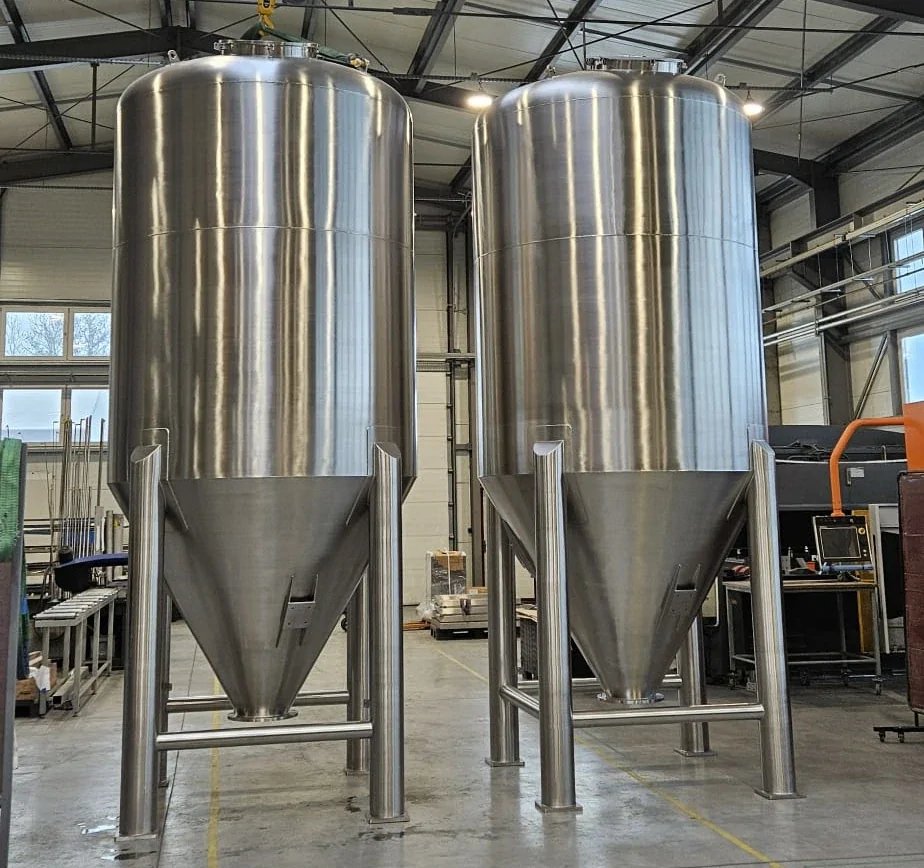


In modern biotechnology, pharmaceutical, cosmetic, and advanced food sectors (encompassing modern brewing, winemaking, distilling, and dairy processing), biosynthesis, biotransformation, and precise multiphase cell culture processes form the absolute foundation of modern production. The manufacturing of advanced active pharmaceutical ingredients (APIs), vaccines, industrial enzymes, organic acids, starter culture bacteria, and niche, high-quality food products relies on the controlled exploitation of the biological potential of living microorganisms – yeasts, bacteria, fungi, and specific mammalian or plant cell cultures.
The apparatus driving this biological revolution is the fermentation tank, also referred to in high-tech terminology as a bioreactor or fermenter. This device has long ceased to be a simple, passive vessel or plain stainless steel silo. A modern fermenter is an ultra-sophisticated, active engineering system designed to simulate, monitor, and continuously maintain an ideal micro-ecological environment within every cubic centimeter of the working medium.
As GMM INOX, building on years of experience in designing and delivering High-Purity process equipment, we are redefining the standards of bioprocess safety, sterility, and efficiency. In this article, we thoroughly analyze design challenges, surface physical chemistry, and metallurgical procedures, proving that we are capable of designing and manufacturing the ideal, personalized fermentation tank tailored precisely to your unique needs and technology.
Physics, Fluid Mechanics, and Process Biology: Challenges at the Intersection of Materials Engineering and Cell Growth Kinetics
Designing an industrial fermentation bioreactor requires an interdisciplinary team of engineers with expertise in advanced fluid mechanics, thermodynamics, metallurgical engineering, and industrial microbiology. Living cells are extremely sensitive structures vulnerable to the slightest anomalies in their environment. Thermal stress, fluctuations in hydrogen ion concentration (pH), improper dissolved oxygen partial pressure ($pO_2$), or excessively high shear forces can lead to immediate lysis (death and rupture) of the cell population or metabolic mutation. This results in the irreversible spoiling of the entire product batch, loss of expensive raw materials, and catastrophic financial downtime for the facility.
When constructing advanced, custom-built fermenters at GMM INOX, we eliminate these risks at the very root by focusing on four key engineering areas:
1. Precise Thermal Dynamics and Energy Balance (Pillow Plate Jackets)
The metabolism of intensively multiplying microorganisms is a highly exothermic process, releasing massive amounts of heat into the surrounding medium. To prevent thermal denaturation of proteins and maintain the process temperature within a strictly defined regime (often with an accuracy of $0.1^\circ\text$), the fermenter must feature a cooling system of the highest efficiency.
At GMM INOX, we utilize advanced pillow plate heating and cooling jackets (embossed plate technology) laser-welded to the inner shell. They feature a unique, corrugated geometry that forces turbulent flow of the cooling medium (e.g., glycol or chilled water), which drastically increases the heat transfer coefficient while reducing wall thickness and the total weight of the apparatus. The entire system is protected by precisely crafted thermal insulation made of technical lamella wool or high-pressure injected PU foam, enclosed within a hermetically welded outer jacket (cladding), eliminating thermal bridges and protecting the system against corrosion under insulation (CUI).
2. Advanced Hydrodynamics and Gas Distribution (Spargers and Mixing Systems)
In aerobic fermentations, the continuous supply of oxygen to cells is a performance-limiting factor. Mass transfer in the gas-liquid system is achieved through specialized aeration nozzles – spargers (ring, pipe, or porous sintered variants) mounted at the lowest point of the vessel bottom.
The gas micro-bubbles introduced under pressure must be evenly dispersed throughout the medium volume using a mixing system. We design dedicated agitator systems (e.g., Rushton turbines for intensive gas dispersion, anchor agitators for high-viscosity media, or hydrofoil propellers for shear-sensitive cultures) that guarantee an excellent homogenization profile without destroying the delicate cell walls of microorganisms. Drive powers, shaft diameters, and mechanical seals (dry or with a liquid barrier) are selected individually for each project.
3. Absolute Asepsis and Elimination of Dead Legs
The greatest enemy of biotechnological processes is external contamination (infection by wild strains of microorganisms from the air or surroundings). A single foreign bacterial cell is enough to dominate the culture and ruin weeks of reactor operation.
The design of GMM INOX fermenters is based on strict adherence to EHEDG and ASME BPE guidelines. This means the complete elimination of so-called dead zones – areas where liquid flow is impaired (e.g., excessively long connection necks) that would prevent effective cleaning. All automation connections (pH and $pO_2$ probes, temperature sensors, conductivity meters) and sampling valves are implemented using hygienic sterile connections (e.g., compliant with DIN 11864 or Tri-Clamp standards), where seals perfectly flush with the inner wall of the vessel, leaving no room for the growth of bacterial cultures.
High-Purity Metallurgy: The Role of AISI 316L Stainless Steel in Biological Processes
The environment inside a fermentation tank is chemically and biologically aggressive. High concentrations of organic compounds, fatty acids, mineral salts, as well as intensive chemical cleaning procedures provide an ideal breeding ground for corrosive processes. For this reason, at GMM INOX, we use exclusively top-quality, certified AISI 316L (PN-EN 1.4404) stainless steel with low carbon content and an addition of molybdenum (2-3%) for the internal wetted parts of our fermenters.
However, high metallurgical grade alone is not enough. The guarantee of biological cleanliness is the topography and structure of the surface metal layer. All internal surfaces of our fermentation tanks undergo rigorous mechanical grinding processes, followed by in-house electropolishing.
This process removes microscopic welding and rolling irregularities at the atomic level, yielding an ideally smooth, mirror-like surface with a roughness coefficient of $R_a < 0,4\ \mu\text$ (pharmaceutical standard), and down to $R_a < 0,2\ \mu\text$ upon client request. On a surface prepared this way, bacteria and proteins are unable to anchor and form a biofilm, ensuring that automated cleaning and sterilization processes are 100% repeatable and effective.
Hygienic and Operational Standards: Designing for Rigorous CIP and SIP Procedures
Regardless of whether you are planning enzymatic production or advanced alcoholic fermentation, your vessel must be adapted to aggressive, cyclical sanitation procedures. Stainless steel subjected to our treatment exhibits complete resistance to two key cleaning processes without the need to disassemble any components of the apparatus:
- CIP (Clean-in-Place): A process involving spraying chemically aggressive cleaning solutions onto the internal walls of the tank via precisely selected spray heads (rotary or static). Typically, a 1–2% sodium hydroxide ($\text$) solution and nitric acid ($\text_3$) at temperatures reaching up to $85^\circ\text$ are used. AISI 316L stainless steel processed in GMM INOX facilities is completely inert to this chemical impact; it does not react with detergents, tarnish, or suffer chemical erosion, protecting your product from metal ion contamination.
- SIP (Sterilization-in-Place): The thermal sterilization phase following cleaning, using saturated steam introduced into the tank under specific pressure. Temperatures inside the apparatus then reach from $121^\circ\text$ to $134^\circ\text$. Under such conditions, standard composite materials or plastics would deform or undergo polymer degradation. Our acid-resistant stainless steel tanks maintain full mechanical and geometric stability, and their design allows for safe operation under cycles of continuous heating and rapid cooling (thermal shock) without the risk of shaft mechanical seal depressurization.
Manufacturing Technology: Uncompromised TIG Welding and Pressure Equipment Validation (PED 2014/68/EU)
Fermentation tanks during steam sterilization cycles (SIP) operate under significant overpressure (often on the order of 2.5 – 3.0 bar at temperatures up to $134^\circ\text$), and during certain technological processes (e.g., vacuum suction of raw materials or degassing) they require the generation of a deep vacuum. This automatically classifies them as pressure equipment that must strictly comply with the European PED 2014/68/EU directive.
The creation of a safe, leak-tight, and durable pressure structure made of acid-resistant steel depends directly on welding craftsmanship. At GMM INOX, welding processes are carried out using the TIG (Tungsten Inert Gas) method and modern orbital welding machines under strict shielding gas protection (argon with a purity of at least 4.8 or 5.0) on both the face and root sides of the weld (argon purging / backing). This prevents chromium oxidation (so-called steel "burning") and the formation of pores, blisters, or slag inclusions.
Every internal weld in contact with the biological medium is ground by our craftsmen to be flush with the base metal face to maintain the $R_a$ roughness continuity regime. After mechanical assembly, the welded structures undergo pickling and chemical passivation processes using dedicated preparations, which fully rebuilds the natural chromium oxide nanolayer responsible for corrosion resistance. Before leaving the facility, each fermenter undergoes rigorous quality control using non-destructive testing (NDT) methods – including penetrant testing (PT) as well as radiographic (RT) or ultrasonic (UT) testing.
Need a fermentation tank? At GMM INOX, we will design and manufacture it specifically for you!
In bioprocess engineering, standardization and mass production are a utopia. Every cell culture, every unique biomass propagation technology or protein synthesis has completely different rheological, dynamic, and kinetic characteristics. For example, thick and viscous brewing wort behaves hydrodynamically completely differently than an ultra-pure liquid phase in vaccine production or an algae cultivation reactor. Attempting to adapt a serial, universal catalog tank to an advanced biotechnological process almost always results in a drastic drop in efficiency, cleaning issues, or a total lack of repeatability across subsequent batches.
At GMM INOX, we build our primary market advantage on a fundamental principle: we do not sell off-the-shelf products from a warehouse – every fermentation tank, reactor, or mixer is built from scratch, to order, strictly according to your individual technical specification and technological guidelines. Our collaborative partnership process with the client is a comprehensive, fully transparent engineering path:
1. Individual Planning, Design, and Technological Audit
You don't have to worry about engineering details – we are the ones who transform your process requirements into a finished technical design. Together with your team of technologists, we analyze the input process parameters in detail:
- the type and biological characteristics of microorganisms,
- viscosity, density, and the foaming tendency of the medium,
- the exact temperature profile and kinetics of exothermic heat release,
- the specifics of feed media (feeding nutrients, acids/bases for pH correction),
- required control and measurement automation systems (number and arrangement of measuring nozzles).
2. CAD/3D Engineering Design and FEM Strength Simulations
Our extensive design department creates a complete, three-dimensional digital model of your future bioreactor. We perform advanced finite element method (FEM) strength simulations of pressure elements, optimizing the geometry of the heads (ellipsoidal, torispherical, conical), selecting optimal wall thicknesses, and configuring the power, speed, and torque of the agitator motor drive. This gives you the assurance that the device will be safe, stable, and perfectly matched to your facility infrastructure.
3. Craftsmanship Production and Advanced Assembly Under One Roof
We possess a modern, integrated machinery park, which means we control the entire production process 100% independently – without the involvement of unverified subcontractors. From precise laser cutting of sheet metal, through numerical rolling, certified TIG welding, to the assembly of advanced fittings:
- dead-leg-free bottom valves (e.g., tank-bottom valves),
- sterile sampling valves,
- sight glasses with integrated wipers and energy-efficient LED backlighting,
- dedicated aeration systems and control panels.
4. Full Qualification and Complete Validation Documentation
We fully understand the audit rigors of the Office of Technical Inspection (UDT) and international pharmaceutical inspections (GIF, FDA). Therefore, we deliver our equipment along with a complete technical documentation package: 3.1 material certificates for all used sheets, pipes, and fasteners, surface roughness certificates ($R_a$), welding protocols (WPS, WPQR), calibration certificates for built-in sensors, and documentation necessary to perform IQ (Installation Qualification) and OQ (Operational Qualification) validation.
Summary: Invest in Equipment Tailored to Your Success
By choosing fermentation tanks designed and manufactured by GMM INOX, you gain much more than just a stainless steel device. You gain the assurance that you are investing in apparatus optimized for your unique production process. This directly translates to maximizing biological efficiency, shortening production cycle times, ease of maintaining sterility, and trouble-free, safe operation of the installation for decades to come.
Have an idea for a new product? Expanding your technological line? Need a reliable fermenter? Contact us. Tell us about your process, and we will design and manufacture such a tank specifically for you – with attention to every single millimeter of the weld.

