

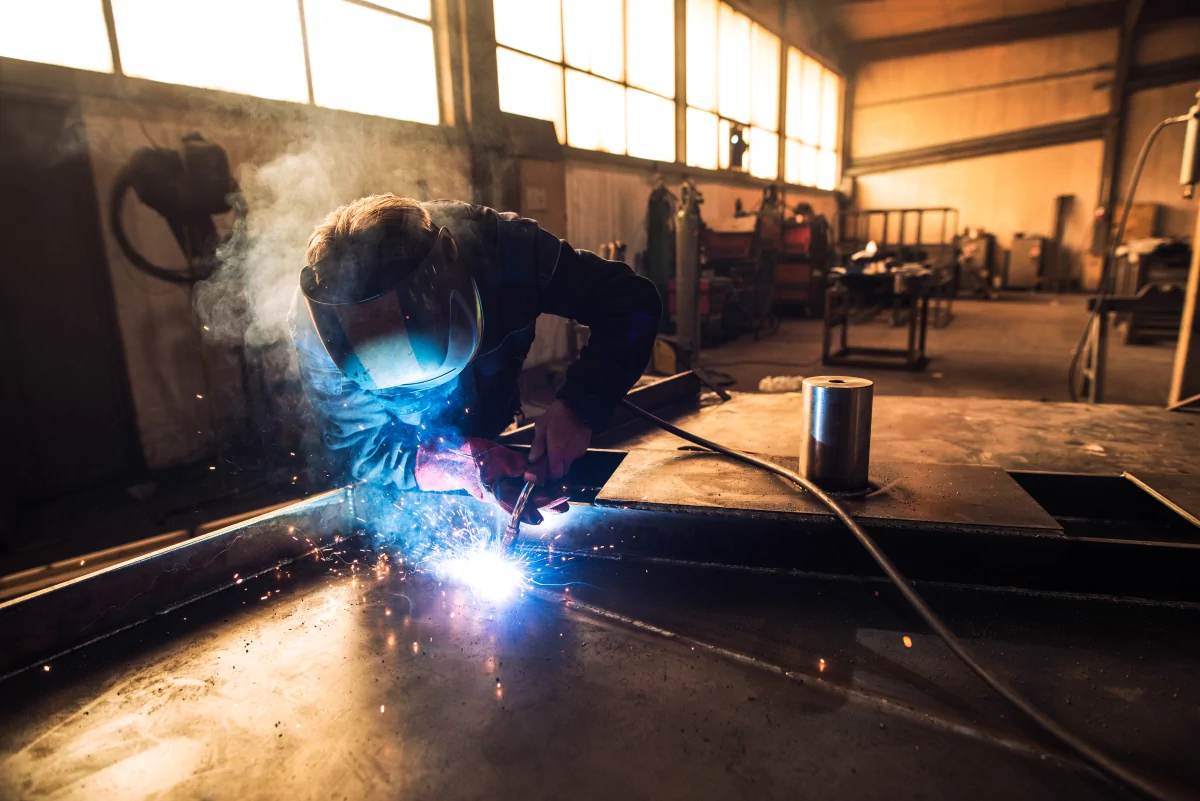


Welding is about far more than choosing the right power source and filler material. The quality of a finished weld, the efficiency of the process and the safety of the operator all depend heavily on how the workstation is equipped.
A skilled welder needs reliable personal protective equipment, suitable clamping systems, tools for preparing and finishing the workpiece, measuring equipment and effective fume control. Each of these elements contributes to a more controlled and repeatable welding process.
This becomes particularly important in industrial fabrication, where a weld is expected to meet specific requirements for strength, geometry, repeatability and appearance. Small inefficiencies at the workstation can quickly translate into lost production time when the same operation is repeated dozens or hundreds of times.
So which welding accessories genuinely make a difference? Below we look at the tools and equipment that should form part of a well-organised professional welding station, including accessories used for TIG, MIG/MAG and MMA welding.
Why welding accessories matter
A high-quality welding machine alone does not guarantee a high-quality joint.
Before the arc is struck, the welder must prepare the material, position the components correctly and ensure that the joint is properly secured. Once welding is complete, the joint may need to be cleaned, measured and inspected before the component moves to the next stage of production.
A typical welding operation may therefore involve:
- surface preparation,
- cutting and edge preparation,
- positioning the components,
- clamping and tack welding,
- setting the welding parameters,
- carrying out the weld,
- cleaning the joint,
- dimensional inspection,
- final finishing.
Every stage requires appropriate equipment.
In professional fabrication, welding accessories should therefore be considered part of the overall production system rather than optional extras.
At GMM INOX, welding forms part of a broader industrial manufacturing process involving stainless steel, acid-resistant steel and other materials. The company carries out TIG and MIG/MAG welding for industrial components and larger fabricated structures.
You can learn more about our capabilities on the GMM INOX welding services page.
Welding helmet – essential protection for every welder
Why a good welding helmet matters
A welding helmet is one of the most important pieces of equipment at any welding station.
Its primary role is to protect the welder’s eyes and face from the intense radiation generated by the arc, as well as from sparks, heat and molten metal spatter.
Modern professional helmets are usually fitted with an auto-darkening filter, often referred to as an ADF. The filter remains relatively light before welding begins and automatically darkens as soon as the arc is detected.
This makes it easier to:
- position the torch accurately,
- start the weld in the correct location,
- carry out tack welds,
- inspect the joint between passes,
- work in awkward or restricted positions.
The benefit is not simply convenience. Better visibility can also improve control over the start of the weld and reduce unnecessary movement.
What should a welder look for in a welding helmet?
When choosing a professional welding helmet, it is worth considering:
- adjustable shade range,
- filter reaction time,
- sensitivity settings,
- field of vision,
- helmet weight,
- headgear adjustment,
- grinding mode,
- availability of replacement lenses,
- compatibility with respiratory protection.
For TIG welding, the sensitivity of the auto-darkening filter is especially important because the process may be carried out at relatively low amperages.
Ergonomics also matters. A welder may wear a helmet for many hours during a shift, so poor balance or unnecessary weight can contribute to neck and shoulder fatigue.
Welding gloves – protection without sacrificing control
A welder’s hands are exposed to heat, sharp edges, hot workpieces and molten metal.
Welding gloves must therefore provide appropriate protection while still allowing sufficient control of the torch and filler material.
The ideal glove depends heavily on the welding process.
Gloves for TIG welding
TIG welding requires a high degree of dexterity.
The welder usually controls the torch with one hand while feeding filler rod manually with the other. Thick, rigid gloves may therefore make precise torch manipulation and filler feeding unnecessarily difficult.
TIG gloves are typically designed to provide a better balance between heat protection and finger movement.
Gloves for MIG/MAG and MMA welding
MIG/MAG and MMA welding can expose the operator to higher levels of spatter and radiant heat.
Gloves used for these processes generally place greater emphasis on thermal and mechanical protection.
Regardless of the process, welding gloves should fit correctly. Oversized or badly shaped gloves can make accurate torch control more difficult and may increase fatigue during prolonged welding work.
Protective clothing and footwear
A welding helmet and gloves are only part of the personal protective equipment required at a welding workstation.
Depending on the process and working conditions, additional protective equipment may include:
- welding jackets,
- protective trousers,
- leather aprons,
- welding sleeves,
- hoods,
- gaiters,
- safety footwear.
The correct PPE should always be selected according to the hazards present at the specific workstation.
Welding produces heat, sparks and molten particles, and protective clothing needs to reduce the risk of these reaching the skin or becoming trapped in ordinary clothing.
For professional industrial welding, PPE selection should form part of the overall risk assessment rather than being treated as a generic one-size-fits-all solution.
Welding table – the basis of accurate fabrication
A good welding table can make a considerable difference to both accuracy and productivity.
The table provides a stable reference surface for positioning and securing components before tack welding and final welding begin.
Modern modular welding tables often use a perforated top that accepts a range of:
- clamps,
- stops,
- squares,
- locating pins,
- supports,
- fixtures.
This makes it possible to reproduce the same setup repeatedly.
For one-off fabrication, that means faster positioning. In production work, it can significantly improve repeatability.
Instead of measuring every component from scratch, the operator can create a fixture arrangement and locate subsequent parts in the same position.
The result is better dimensional consistency and less time spent correcting alignment problems later.
Welding clamps, grips and vices
Correct positioning is one of the foundations of a good welded assembly.
Components that move during tack welding or distort because they have not been secured properly can create dimensional problems that become increasingly difficult to correct as fabrication progresses.
Common clamping tools include:
- F-clamps,
- C-clamps,
- quick-action clamps,
- table clamps,
- vices,
- angle clamps.
They allow the welder or fabricator to hold workpieces securely while checking alignment and carrying out tack welds.
This is particularly important when welding frames, box sections, brackets and larger fabricated assemblies.
Proper clamping does not eliminate welding distortion, but it gives the operator far greater control over the process.
Magnetic welding squares
Magnetic welding squares are among the simplest accessories in a welding workshop, yet they can save a considerable amount of time.
They allow steel components to be positioned temporarily at common angles such as:
- 45°,
- 90°,
- 135°.
They are particularly useful when fabricating:
- frames,
- box-section structures,
- brackets,
- corners,
- small assemblies.
A magnetic square can hold two components in position while the welder makes initial tack welds.
It should not, however, replace dimensional inspection.
Where tight tolerances are required, the assembly should still be checked using appropriate measuring equipment before final welding begins.
Wire brushes – simple but important welding tools
Surface cleanliness has a direct influence on the welding process.
Rust, scale, paint, oxides and other surface contamination can interfere with arc stability and contribute to weld defects.
Wire brushes are therefore among the most frequently used tools at a welding station.
They may be used to:
- clean the joint before welding,
- remove loose contamination,
- clean the weld between passes,
- remove residues after welding.
Stainless steel requires dedicated tools
When working with stainless steel, special care is required.
A wire brush that has previously been used on carbon steel should not subsequently be used on stainless steel.
Particles of carbon steel can become embedded in the stainless surface and may later contribute to localised corrosion and surface contamination.
For this reason, stainless fabrication workshops should maintain separate, clearly identified brushes, abrasives and other contact tools for stainless steel.
The same principle applies to many grinding and finishing tools.
At GMM INOX, stainless steel welding forms an important part of our industrial welding services, making careful control of tooling and surface preparation particularly important.
Angle grinder and suitable abrasives
Few welding workshops operate without an angle grinder.
It is used throughout fabrication for operations such as:
- cutting material,
- preparing edges,
- cleaning weld areas,
- removing scale,
- dressing welds,
- removing sharp edges,
- preparing surfaces for further finishing.
The grinder itself is only part of the system. Choosing the correct disc or abrasive is equally important.
Depending on the task, a welder or fabricator may use:
- cutting discs,
- grinding discs,
- flap discs,
- non-woven abrasives,
- stainless steel finishing products.
The correct choice depends on the base material and the required surface finish.
Care is particularly important when working with stainless steel. Abrasives contaminated with carbon steel can compromise the cleanliness of the finished component.
It is also important to remember that a weld should not automatically be ground flush simply for appearance. The required weld geometry and structural function should always take priority.
Chipping hammer – particularly useful for MMA welding
A chipping hammer is most commonly associated with MMA, or manual metal arc welding.
When welding with coated electrodes, slag forms over the weld bead. This must usually be removed before inspection or before the next weld pass is deposited.
A chipping hammer is used to break away the slag, after which a wire brush can be used to clean the surface further.
For welders who mainly work with TIG, a chipping hammer may see little use. For MMA work, however, it remains a basic workshop tool.
This illustrates an important point: welding equipment should always be selected according to the process being used rather than from a generic list of accessories.
MIG/MAG welding pliers
A good pair of MIG/MAG welding pliers can replace several small hand tools at the workstation.
Depending on their design, they can be used to:
- cut welding wire,
- clean the gas nozzle,
- remove the nozzle,
- tighten or loosen contact tips,
- remove accumulated spatter.
Individually, these tasks take only a few seconds.
During a full production shift, however, repeatedly stopping to find different tools can result in considerable wasted time.
Keeping dedicated MIG/MAG pliers close to the welding station helps keep routine torch maintenance quick and straightforward.
Anti-spatter products
Spatter is a familiar issue in MIG/MAG welding.
Molten particles can adhere to the workpiece and build up inside the welding torch nozzle.
Anti-spatter products are designed to reduce adhesion and make subsequent cleaning easier.
They can help:
- reduce cleaning time,
- keep gas nozzles cleaner,
- minimise mechanical removal of spatter,
- improve workstation efficiency.
The product selected should always be compatible with subsequent manufacturing processes.
This is particularly important if the fabricated component will later be painted, powder coated, galvanised or subjected to another surface treatment.
Residues left on the workpiece can interfere with subsequent coating processes if the wrong product is used.
Gas regulator, pressure gauge and flowmeter
Shielding gas plays a fundamental role in TIG and MIG/MAG welding.
The gas protects the molten weld pool and surrounding hot metal from contamination by the atmosphere.
A properly equipped gas system typically includes:
- regulator,
- pressure gauge,
- flowmeter,
- suitable hoses,
- reliable connections.
Gas flow should be set correctly for the process, torch and welding conditions.
More gas is not necessarily better.
Excessive flow can create turbulence and may actually draw atmospheric contamination into the shielding zone.
Leaks are another common source of wasted gas and process instability, so hoses and connections should be inspected regularly.
A suitable leak-detection product can also be useful during maintenance.
Welding leads and earth clamp
The condition of welding cables is sometimes overlooked until a problem appears.
Damaged insulation, poor electrical connections or an ineffective return clamp can all affect the performance of the welding system.
A professional welder should routinely inspect:
- cable insulation,
- connectors,
- return clamps,
- torch connections,
- high-wear areas,
- signs of overheating.
Cables and connectors must also be properly rated for the welding current and duty cycle of the equipment.
A poor earth connection may result in unstable arc behaviour and inconsistent welding performance.
Maintaining these basic components is therefore just as important as maintaining the welding machine itself.
Tungsten electrode grinder for TIG welding
The condition and geometry of the tungsten electrode have a direct influence on TIG welding performance.
For professional TIG work, using a dedicated tungsten grinder can improve consistency.
A purpose-built grinder helps to:
- produce repeatable electrode geometry,
- maintain the correct grinding direction,
- prepare electrodes more quickly,
- reduce contamination risk,
- improve repeatability between welders.
In production environments it is often worth preparing several tungsten electrodes in advance.
If an electrode becomes contaminated during welding, the operator can replace it immediately rather than stopping the process to regrind it.
This small improvement can make a noticeable difference in productivity when TIG welding is carried out throughout the working day.
Measuring tools and weld gauges
A welded assembly should not be assessed by eye alone.
Basic inspection tools should therefore be readily available at the workstation.
Useful equipment may include:
- vernier callipers,
- steel rules,
- tape measures,
- engineers’ squares,
- feeler gauges,
- weld gauges,
- dedicated inspection templates.
Depending on the gauge used, the welder or inspector may be able to check dimensions such as weld size, reinforcement or joint preparation.
Dimensional inspection should also take place during fabrication, not only once the assembly has been fully welded.
Detecting misalignment early is considerably easier than trying to correct it after a large structure has been completed.
Welding fume extraction and respiratory protection
Welding accessories should never be considered purely in terms of convenience or productivity.
Welding fumes are one of the most important occupational hazards associated with the process.
Wherever possible, fumes should be controlled at source using suitable engineering controls.
Local exhaust ventilation is particularly effective when the extraction point is positioned close to the arc.
&amp;amp;amp;amp;amp;amp;amp;amp;amp;amp;amp;amp;amp;amp;amp;lt;span style=”font-weight: 400;”>Depending on the workplace, suitable controls may include:</span>
- fixed extraction arms,
- mobile extraction units,
- integrated torch extraction,
- general ventilation,
- filtered welding systems.
Respiratory protective equipment may also be required where engineering controls alone cannot reduce exposure sufficiently.
Powered air-purifying respirator systems integrated with welding helmets are increasingly used in professional environments because they combine eye, face and respiratory protection.
The correct solution should always be based on a workplace risk assessment and the materials being welded.
Stainless steel welding requires particular attention because the composition of the welding fume may differ from that produced when welding ordinary carbon steel.
Welding screens and curtains
The welding arc can affect people who are not directly involved in the welding operation.
In workshops where several employees work in the same area, welding screens and curtains help separate the welding zone from surrounding workstations.
They are particularly useful in:
- fabrication workshops,
- large production halls,
- multi-bay welding areas,
- maintenance departments,
- assembly areas.
The aim is not simply to protect the welder, but to create a safer working environment for everyone nearby.
The welding station should therefore be considered as part of the wider workplace layout.
Welding trolley – mobility and organisation
A welding trolley may seem like a minor convenience until the operator regularly needs to move:
- the welding machine,
- gas cylinder,
- cables,
- regulator,
- tools,
- consumables.
A well-designed trolley allows the main components of a mobile welding station to remain together.
This improves organisation and reduces the time required to move equipment between work areas.
In larger fabrication facilities, the same principle can be taken further by creating dedicated mobile welding stations containing the tools and consumables required for a particular process.
Good organisation can have a surprisingly large effect on productivity.
Good workstation lighting
A welder does not only need to see clearly while the arc is active.
Good lighting is equally important when:
- preparing the joint,
- measuring components,
- positioning parts,
- inspecting tack welds,
- checking the completed weld,
- carrying out finishing work.
Additional task lighting can therefore improve both accuracy and working comfort.
Some modern welding helmets also incorporate LED work lights that illuminate the area before and after welding.
This can be particularly useful when working inside structures, vessels or other areas where general workshop lighting is limited.
Choosing accessories for different welding processes
There is no single perfect tool kit for every welder.
The correct equipment depends on the process, material, production environment and type of component being fabricated.
Useful accessories for TIG welding
For TIG welding, useful equipment includes:
- high-quality auto-darkening helmet,
- flexible TIG gloves,
- dedicated tungsten grinder,
- gas flowmeter,
- material-specific wire brushes,
- suitable surface preparation tools,
- precise clamping equipment,
- accurate measuring tools.
TIG welding is particularly well suited to applications where excellent weld quality, process control and appearance are required.
It is widely used for stainless and acid-resistant steels, which are among the materials regularly processed by GMM INOX.
More information about our TIG capabilities is available on the GMM INOX welding services page.
Useful accessories for MIG/MAG welding
For MIG/MAG welding, useful workshop equipment includes:
- MIG/MAG pliers,
- spare contact tips,
- gas nozzles,
- wire liners,
- anti-spatter products,
- regulator and flowmeter,
- wire brushes,
- grinding equipment,
- clamping systems.
In production welding, keeping commonly replaced torch components directly at the workstation can prevent unnecessary downtime.
A contact tip may take only a minute to replace, but repeated trips across the workshop quickly become inefficient.
Useful accessories for MMA welding
A welder using the MMA process will typically require:
- electrode holder,
- welding leads,
- earth clamp,
- chipping hammer,
- wire brush,
- suitable electrode storage,
- appropriate gloves and protective clothing.
For professional applications, electrode storage conditions may also be important depending on the electrode type and welding procedure.
The most useful welding accessory is a well-organised workstation
Buying more tools does not automatically create a more efficient welding station.
Organisation is just as important.
Frequently used equipment should be within easy reach. Consumables should have designated storage locations. Tools used for stainless steel should be kept separate from those used for carbon steel. Welding leads should be routed in a way that does not create unnecessary hazards or restrict movement.
Measuring equipment should be accessible throughout fabrication, not locked away until final inspection.
In high-volume production, saving only ten or fifteen seconds on a repeated operation can become significant when that operation is carried out hundreds of times.
The objective is therefore not to collect as many welding gadgets as possible.
The objective is to create a workstation that allows the welder to work safely, consistently and efficiently.
Welding accessories and the quality of professional welding
Tools cannot replace welding skill, training or experience.
What they can do is provide the conditions in which a skilled welder can work consistently.
A professional welding process requires:
- a stable workstation,
- suitable welding equipment,
- correctly prepared materials,
- appropriate filler metals,
- properly maintained torches and cables,
- reliable clamping,
- accurate measuring equipment,
- effective protection from welding hazards.
All of these elements contribute to process stability.
This is particularly important in industrial fabrication, where welding is often only one stage in a much larger manufacturing process.
After welding, components may move on to machining, surface finishing, assembly, testing or installation as part of a larger industrial system.
A dimensional or quality problem created at the welding stage can therefore affect several subsequent operations.
For this reason, professional welding should be approached as a controlled manufacturing process rather than simply the act of joining two pieces of metal.
GMM INOX provides professional TIG and MIG/MAG welding as part of its wider industrial fabrication capabilities. Find out more about our experience, technologies and materials on the GMM INOX welding services page.

