

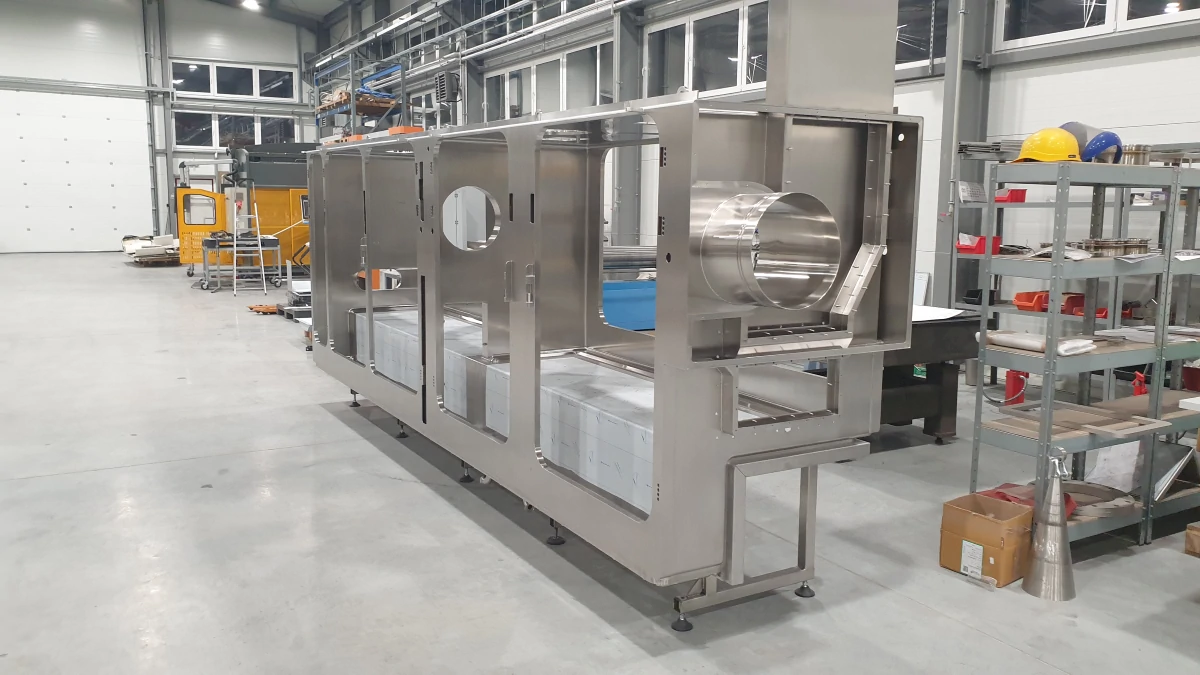


In the food industry, the requirements for hygiene, cleanliness, and durability of technological installations are exceptionally high. Production systems must comply with strict sanitary standards and be engineered for high-purity maintenance, which places specific demands on material joining processes. In these demanding environments, TIG welding combined with stainless steel has become the global industry standard—not only for joint integrity but also for safety and hygienic surface finish.
This article provides a technical overview of why TIG welding and corrosion-resistant alloys are the preferred choice for food production, the standards that must be met, and the best practices for ensuring quality and operational safety.
1. Technical Definition: TIG Welding
TIG welding (Tungsten Inert Gas), also classified as GTAW (Gas Tungsten Arc Welding), is an arc welding process utilizing a non-consumable tungsten electrode to generate an electric arc. The weld zone is protected by an inert shielding gas—typically high-purity argon.
TIG is highly valued for its precision, weld cleanliness, and the ability to join thin-walled components. This makes it the ideal choice for the food industry, where intricate tubing and thin-gauge sheet metal assemblies are common.
2. Stainless Steel: The Foundation of Food-Grade Engineering
Stainless steel is the primary material for technological installations due to its passivation properties and resistance to organic acids and detergents. Key characteristics include:
Corrosion Resistance: High resistance to oxidation ensures the long-term reliability of process systems.
Hygienic Maintenance: Smooth surfaces facilitate effective CIP (Cleaning-In-Place) and disinfection.
Metallurgical Stability: Certified grades do not migrate substances into the food-contact environment.
Mechanical Integrity: Superior resistance to thermal stress and operational loads.
The most critical grades for food applications are AISI 304 and AISI 316L (the latter featuring molybdenum for enhanced chemical resistance).
3. Why TIG Welding is Ideal for High-Purity Applications
The TIG process offers unmatched arc control, resulting in:
Minimal Contamination: Zero spatter or slag, eliminating the risk of foreign particulates in the production line.
Smooth Weld Geometry: Enables dead-leg free design and aesthetic joints without extensive post-weld finishing.
Thermal Control: Prevents material burn-through on thin-walled process piping.
4. Global Standards and Quality Compliance
Food-grade installations must adhere to rigorous regulatory frameworks:
HACCP: Hazard Analysis and Critical Control Points.
ISO 22000: International food safety management systems.
EHEDG & ASME BPE: Standards for hygienic design and surface roughness ($R_a$).
FDA & EU Regulations: Compliance for materials intended for food contact.
5. Strategic Applications in Food Production
5.1 Process Pipelines
High-purity pipelines must be free of pores and discontinuities. TIG welding ensures hermetic integrity, minimizing the risk of microbiological growth.
5.2 Aseptic Storage and Process Tanks
For liquid raw materials, joint durability is paramount. TIG welds on stainless steel vessels guarantee corrosion resistance and easy sterilization.
5.3 Mixing and Separation Equipment
Precise workmanship and the absence of burrs or crevices are essential in mixers and separation chambers to prevent material build-up.
6. The TIG Welding Workflow: Step-by-Step
Material Preparation: Removing contaminants and oxides to ensure a high-quality weld pool.
Shielding Gas Optimization: Utilizing Grade 5.0 Argon or specialized mixtures.
Parameter Calibration: Precision setting of current, voltage, and travel speed.
Welding Execution: Expert guidance of the arc to maintain a consistent weld bead.
Quality Assurance (QA): Visual inspection and Non-Destructive Testing (NDT).
Pickling and Passivation: Chemical treatment to restore the chromium-oxide protective layer.
7. Critical Success Factors for Weld Quality
Surface Preparation: Contamination directly leads to porosity and weld failure.
Gas Shielding Stability: Inconsistent gas flow compromises the metallurgical integrity of the joint.
Operator Expertise: High-level craftsmanship is required for precise arc manipulation.
8. Health, Safety, and Environmental (HSE) Standards
Operations must prioritize Occupational Health and Safety (OHS):
PPE Compliance: Use of auto-darkening helmets and flame-resistant protective clothing.
Fume Extraction: High-efficiency local exhaust ventilation to manage metallic fumes.
Workplace Isolation: Utilizing welding screens to protect personnel from UV/IR radiation.
9. Summary: The Quality Standard in Modern Manufacturing
TIG welding combined with stainless steel is more than a technical choice—it is a commitment to operational safety and hygienic excellence. By adhering to strict process controls and selecting the appropriate metallurgical grades, GMM INOX ensures that every installation meets the highest global standards for durability and food safety.

