

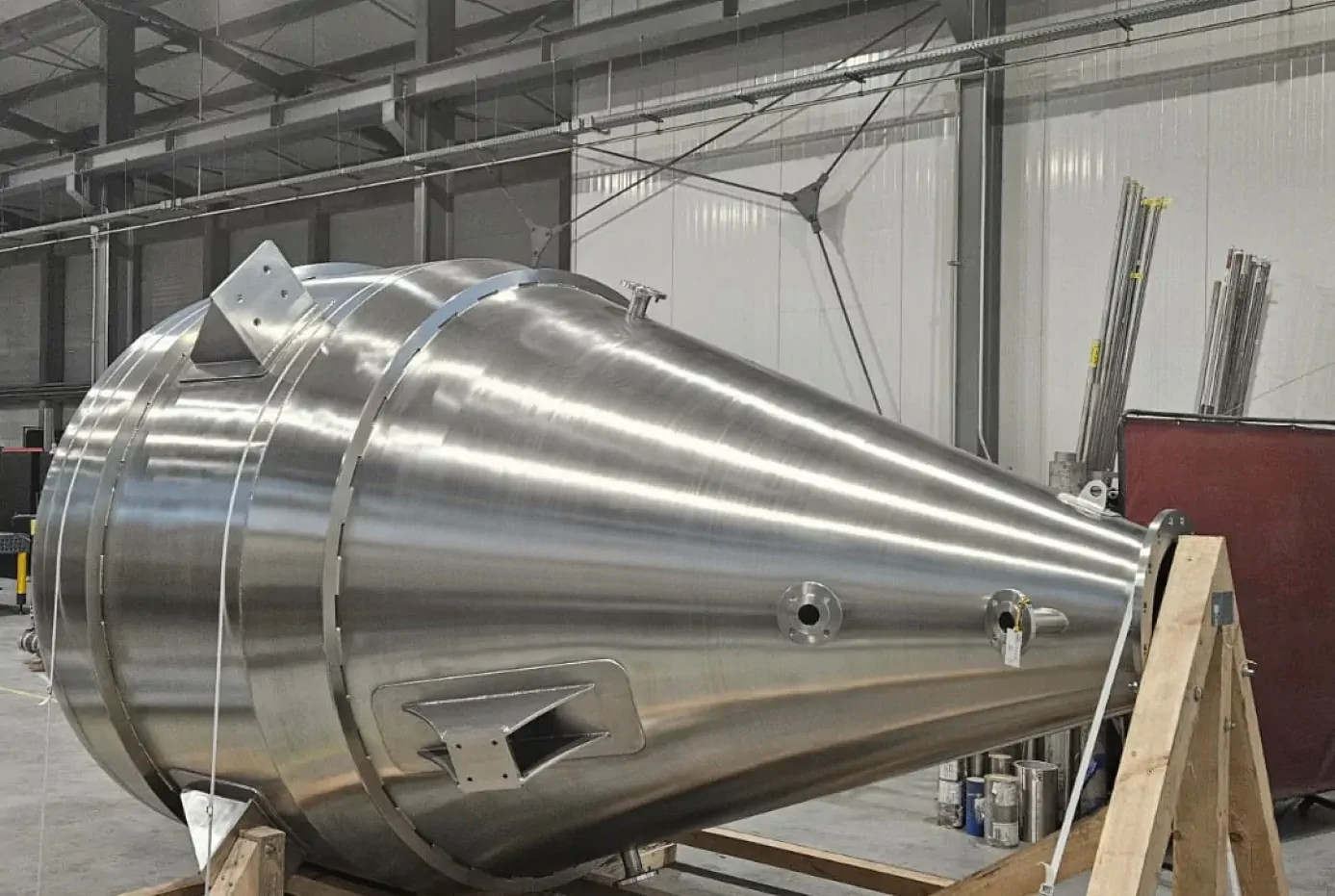


In modern food, pharmaceutical, cosmetic, and chemical processing plants, energy efficiency has evolved beyond sustainability policy—it is now a critical determinant of production profitability. The core of most process lines is the process vessel. These units facilitate precise chemical reactions, mixing, pasteurization, fermentation, crystallization, and storage of substances under tightly controlled thermal conditions.
Maintaining a stable thermal regime requires more than advanced automation and sensitive instrumentation; it demands an uncompromising passive barrier. Inadequacies during the design or installation phase lead to thermal bridging, significant energy losses, and the severe threat of Corrosion Under Insulation (CUI). In this article, we provide an in-depth analysis of the heat transfer physics of stainless steel vessels, critical structural points, and engineering best practices to achieve peak thermal efficiency.
Thermal Physics and the Critical Functions of Professional Insulation
While the immediate impact on utility costs (technical steam, chilled water, or electricity) is the most obvious financial metric, for the process engineer and maintenance manager, correctly engineered thermal insulation serves several strategic functions:
1. Process Kinetics Stability and Batch Repeatability for Process Vessels
In the pharmaceutical and biotechnological sectors, temperature fluctuations of $0.5^\circ\text$ can jeopardize entire batches, inhibiting enzymatic activity, disrupting crystallization, or irreversibly altering substance viscosity. The insulation must decouple the vessel's microclimate from the dynamic environmental changes of the production floor (e.g., ambient air circulation, seasonal shifts, or heat load from adjacent machinery).
2. Condensation Mitigation (Dew Point Control)
For chilled vessels (e.g., fermentation/lagering tanks in brewing, dairy storage vessels, or cosmetic reactors), defective insulation lowers the external jacket temperature below the dew point. This results in continuous moisture condensation from the ambient air on the shell. Moisture in a production zone represents an immediate breach of hygienic standards—creating an ideal environment for mold, fungi, and bacterial biofilms, which can lead to failure in GMP or HACCP audits.
3. Occupational Health and Safety (OHS)
Process vessels often operate at extreme temperatures, ranging from cryogenic cooling to Sterilization-in-Place (SIP) cycles exceeding $121^\circ\text$ or chemical Cleaning-in-Place (CIP) at $85^\circ\text$. The external cladding must ensure that surface touch temperatures remain within OHS compliance limits (typically a maximum of $50^\circ\text$ for metal surfaces) to eliminate the risk of operator burns.
Material Analysis: Mineral Wool vs. Polyurethane (PU) Foam
The selection of insulating media is one of the most vital design decisions. There is no one-size-fits-all material; the choice depends on the operating temperature profile, vessel geometry, and the facility's specific operational environment.
| Feature / Parameter | Technical Mineral Wool | Polyurethane (PU) Foam |
|---|---|---|
| Thermal conductivity (λ) | Moderate (~0.036 – 0.042 W/mK) | Excellent (~0.022 – 0.026 W/mK) |
| Max. operating temperature | Very high (up to 600°C) | Limited (typically up to 130°C) |
| Fire resistance rating | A1 (non-combustible) | B1 / B2 (self-extinguishing / combustible) |
| Physical structure | Fibrous (susceptible to settling) | Cellular, rigid, and homogeneous |
| Water absorption resistance | Low (requires ideal sealing) | High (closed-cell structure) |
When to Specify Technical Mineral Wool for Process Vessels?
Mineral wool (stone or glass) is an indispensable material for high-temperature installations due to its non-combustibility and chemical stability. The primary engineering challenge with mineral wool is its tendency to settle under gravity and vibration on vertical vessel walls. To mitigate this, professional designs utilize exclusively lamella wool (where fibers are oriented perpendicular to the insulated surface, significantly enhancing compressive strength) or specialized mats on stainless steel wire mesh, secured to the shell via dedicated pins and locking clips.
When is Polyurethane (PU) Foam the Superior Choice?
PU foam (hot-injected or installed as prefabricated segments matched to the vessel radius) is the gold standard for refrigeration insulation. Its closed-cell structure provides an exceptional $\lambda$ value, allowing for a reduction in insulation thickness by nearly half compared to wool while maintaining the same thermal resistance. High-pressure injection enables seamless filling of the void between the vessel and the cladding, eliminating air pockets and ensuring a perfect fit for complex geometries such as vessel heads or pipe connections.
Anatomy of Thermal Bridges: Critical Points in Stainless Steel Vessels
Stainless steel (e.g., AISI 304 or acid-resistant AISI 316L) features relatively low thermal conductivity compared to other metals; however, it remains significantly more conductive than insulation materials. Any structural element that "pierces" the insulation layer, creating a direct path between the vessel interior and the external environment, acts as a high-efficiency heat conduit—a thermal bridge.
Engineers identify three primary risk zones that demand a bespoke design approach:
1. Structural Supports: Feet, Legs, and Vessel Suspension
A process vessel filled with high-viscosity product and equipped with a heavy-duty motorized agitator often weighs several tons. This entire mass must be supported by load-bearing feet. If a vessel leg is welded directly to the internal pressure-rated shell and extends beyond the insulation boundary, it creates a significant thermal bridge. Heat (or cold) is continuously transferred directly into the facility floor or the support skid structure.
- Engineering Solution: Utilize thermal breaks. Specialized insulating spacers made from glass-epoxy laminates or high-strength technical polymers (e.g., PEEK or high-density structural polyurethane) are installed between the leg and the support point. These components provide exceptional compressive strength combined with minimal thermal conductivity. Alternatively, a dual-node support design can be engineered, where the section in contact with the primary vessel shell remains completely encapsulated within the insulation layer.
2. Process Nozzles, Measurement Ports, and Manways
Advanced process vessels require numerous connections: ports for CIP/SIP systems, raw material inlets, bottom outlets, as well as instrumentation ports (pH probes, conductivity sensors, level radar, PT100 temperature sensors). Each penetration disrupts the continuity of the insulation. Poor finishing in these zones results in linear and point heat loss, as well as localized surface frosting on the cladding.
- Engineering Solution: Extend nozzle necks and flanges so that connection points (e.g., Triclamp sanitary fittings or ASEPTIK flanges) remain clearly outside the nominal insulation thickness. The area around the neck is precision-fitted with insulating material, and the external cladding is finished with tight-sealing, flanged rosettes that prevent leaks and ensure proper drainage during external wash-down cycles.
3. Auxiliary Structures and Instrumentation Frames
Mounting cable trays, control cabinets, or drive covers directly to the vessel shell using metal brackets is a classic execution error. It generates dozens of small, difficult-to-detect thermal leakage points.
- Engineering Solution: All auxiliary structures should be mounted directly to the external, load-bearing insulation cladding (provided it has sufficient thickness and rigidity) or attached via dedicated, insulated standoff spacers.
External Cladding and the Destructive Phenomenon of Corrosion Under Insulation (CUI)
Thermal insulation cannot operate in a vacuum—it must be rigorously protected against mechanical damage, dust, and, most importantly, moisture and water ingress. This protective function is fulfilled by the external cladding, typically fabricated from stainless steel with a mirror (polished) or matte (brushed) finish.
A breach in the integrity of the external cladding poses a severe risk of Corrosion Under Insulation (CUI). This is one of the most hazardous and difficult-to-detect degradation processes for industrial equipment. If water penetrates the mineral wool through microscopic gaps in the cladding during intensive chemical facility cleaning, the result is catastrophic:
- Drastic Reduction in Insulation Efficiency: Water has a thermal conductivity coefficient over twenty times higher than the air trapped within mineral wool fibers. Saturated insulation ceases to function as a barrier, leading to massive energy losses.
- Invisible Pitting Corrosion: The warm, humid microclimate existing directly against the vessel wall, combined with chemical cleaning agents (particularly those containing chloride ions), dramatically accelerates stainless steel corrosion. This process develops entirely out of sight beneath the cladding. Often, the first indicator of CUI is a sudden, critical failure of the vessel shell and subsequent product leakage, resulting in astronomical costs related to downtime and emergency repairs.
Engineering 100% Cladding Integrity
- Full Welded Cladding: This is the gold standard in the pharmaceutical industry and demanding food-grade applications. Cladding sheets are neither riveted nor screwed but are entirely TIG-welded, with all seams ground to a smooth finish. This creates a monolithic, hermetically sealed capsule that is completely impervious to high-pressure wash-downs and aggressive disinfectants.
- Interlocking Profiles and Drainage Systems: For mechanically fastened cladding, sheets must be precision-profiled to ensure that the upper sheet overlaps the lower one with a deep, weather-tight lock, preventing gravity-fed water ingress. All riveted joints are further sealed with specialized high-temperature, chemically resistant polyurethane or technical silicone sealants.
- Flanged Collars and Rosettes: Every pipe penetration through the external cladding must be finished with a sealed rosette, either welded to the nozzle pipe or sealed with a dedicated elastomer gasket compliant with FDA and EHEDG guidelines.
Custom Engineering vs. Serial Production: Why Standard Approaches Fail
In the process industry, no two projects are identical. Every medium—from liquid nitrogen, milk, and beer to high-viscosity sugar syrups or pharmaceutical ointments—requires a unique temperature distribution profile. The design of a process vessel's insulation must be seamlessly integrated with its heating and cooling technology.
A vessel equipped with an advanced pillow plate heating jacket features highly intensive heat transfer and high operating pressures. The insulation design must account for not only the energy balance but also linear thermal expansion. Stainless steel physically expands under high temperatures. If the insulation and outer cladding are installed "rigidly"—without providing for thermal expansion and material compliance—thermal stresses will inevitably cause cladding deformation, welding fracture, and total system compromise.
Optimal selection of insulation technology requires a multi-criteria engineering analysis, including:
- Precise calculation of insulation thickness based on target ambient temperatures and permissible medium temperature decay over time.
- Determination of the dew point to prevent condensation in chilled tanks.
- Analysis of the production sequence: The installation of insulation and cladding is a critical final stage, which must only commence following the successful completion of all Non-Destructive Testing (NDT) procedures—such as radiographic (RT), ultrasonic (UT), or penetrant (PT) testing—on the vessel's pressure-retaining welds.
At GMM INOX, we understand that the reliability of a process vessel depends on the precision of the smallest detail. Therefore, we do not rely on generic, one-size-fits-all templates. Every project is executed to order, strictly following the customer's individual specifications—from advanced thermal modeling, CAD/3D engineering, and precision laser cutting to heavy-gauge metal rolling, final expert assembly, and chemical passivation of welds. This vertical integration of production processes under one roof guarantees that the finished product is 100% free of structural defects and hidden thermal bridges.
Summary
Thermal insulation of process vessels is a facet of industrial engineering that directly impacts the Operational Expenditure (OPEX) of any production facility. Consciously mitigating thermal bridges through the use of insulated structural breaks, hermetic nozzle-penetration sealing, and flawless execution of fully welded outer cladding protects the equipment against destructive Corrosion Under Insulation (CUI) and ensures the stability of technological processes. Choosing a specialized partner with advanced manufacturing capabilities, who can design and build equipment tailored exactly to the unique operational parameters of your facility, is the key to failure-free, safe, and energy-efficient production for decades to come.

