

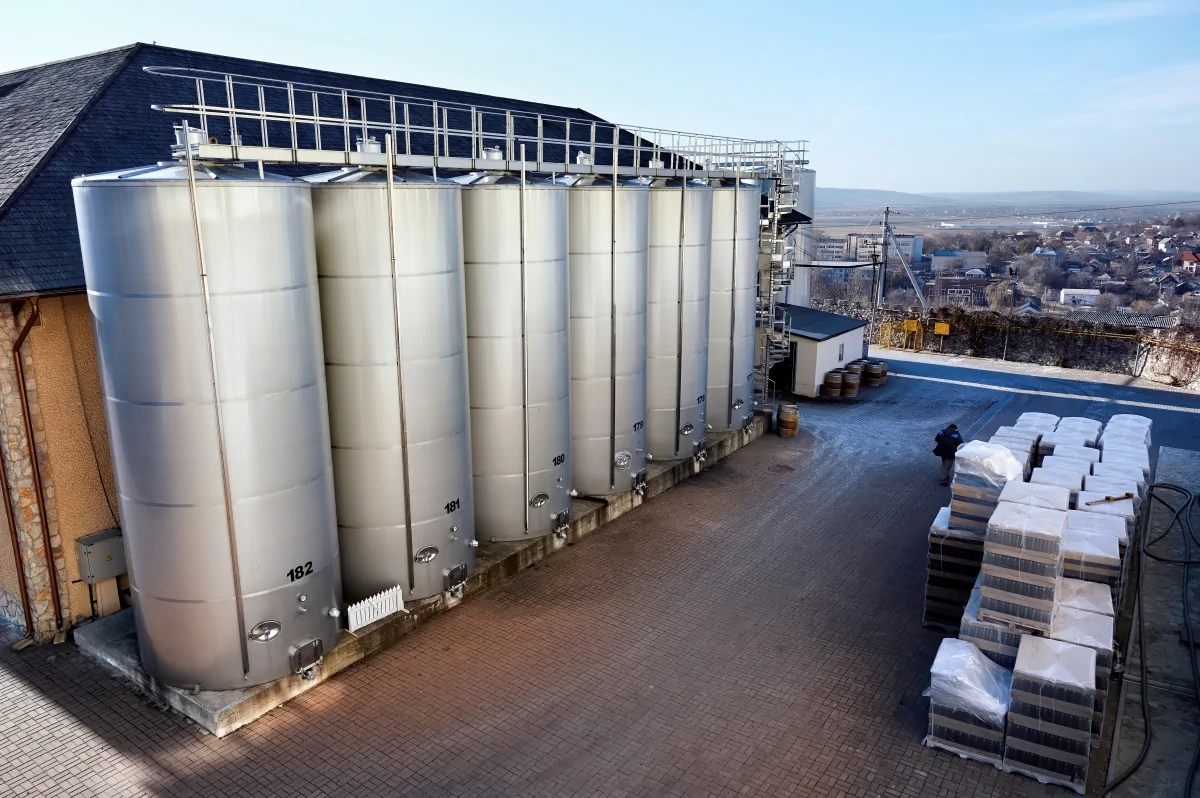


Buying a stainless steel storage tank should involve much more than simply choosing the required capacity and overall dimensions. The tank needs to be matched to the stored medium, operating conditions, filling and discharge method, hygienic requirements and the space available within the installation.
A tank used for storing water or low-viscosity liquids will have different design requirements from one intended for chemically aggressive substances, viscous products or materials used in the food, cosmetic or pharmaceutical industries.
The grade of stainless steel, tank orientation, bottom design, nozzle arrangement, level monitoring and cleanability can all have a significant impact on day-to-day operation.
So what should you consider before purchasing a stainless steel storage tank?
Start with the Product or Medium Being Stored
The most important factor when specifying a storage tank is the medium that will be stored inside it.
Tank selection should never be based on capacity alone. The properties of the product directly influence the construction material, internal finish, tank geometry and required equipment.
Before specifying the tank, it is worth defining:
- type of product or raw material,
- chemical composition,
- density,
- viscosity,
- storage temperature,
- chemical aggressiveness,
- hygienic requirements,
- tendency to settle or separate,
- sensitivity to environmental exposure.
Material compatibility is particularly important. The tank construction must withstand continuous contact with the stored product without compromising its integrity or contaminating the medium.
How to Select the Right Storage Tank Capacity
Tank capacity should be based on the actual operating requirements of the installation rather than simply the maximum quantity of product to be stored.
It is important to distinguish between:
- total tank volume,
- working volume,
- minimum operating level,
- maximum filling level.
A storage tank will not necessarily operate at 100% of its nominal capacity. Sufficient free space may be required depending on the product, filling method and process conditions.
Capacity selection should also consider:
- production batch size,
- delivery frequency,
- product consumption rate,
- required buffer stock,
- future production requirements.
An undersized tank may interrupt production or require more frequent deliveries, while an unnecessarily oversized tank increases both investment cost and space requirements.
Vertical or Horizontal Storage Tank?
One of the fundamental design choices is whether the tank should be vertical or horizontal.
Both arrangements can be used effectively, but the correct choice depends on the available space, the stored product and how the tank will be integrated into the installation.
Vertical Storage Tanks
Vertical tanks are often preferred where floor space is limited.
Their relatively small footprint allows a large volume to be stored without occupying excessive production or warehouse space.
A vertical arrangement may also support gravity-assisted discharge, particularly where the bottom geometry and outlet position have been designed accordingly.
Horizontal Storage Tanks
Horizontal tanks may be more suitable where installation height is restricted or where the surrounding pipework and equipment favour a lower-profile arrangement.
The decision should take into account:
- available floor area,
- available installation height,
- supporting structure,
- filling and discharge arrangement,
- product characteristics,
- access for inspection and maintenance.
The orientation should therefore be selected as part of the overall system design rather than simply on the basis of available dimensions.
AISI 304 or AISI 316L – Which Stainless Steel Grade Should You Choose?
The term “stainless steel” covers a wide range of materials with different corrosion resistance and mechanical properties.
Two grades commonly used in process and storage equipment are AISI 304 and AISI 316L, but the correct choice depends on the application.
Important factors include:
- chemical composition of the stored product,
- operating temperature,
- cleaning chemicals,
- surrounding environment,
- hygiene requirements,
- presence of chlorides or other corrosive substances.
There is no single stainless steel grade that is suitable for every storage application.
Selecting an inappropriate material may shorten the service life of the tank and increase the risk of corrosion, maintenance problems or product contamination.
Tank Bottom Design Matters
The shape of the tank bottom affects drainage, cleanability and the amount of residual product remaining after discharge.
Different bottom geometries can be selected depending on the product and operating requirements.
For free-flowing liquids, a relatively simple design may be sufficient. More viscous products or media containing solids may require a geometry that promotes more complete discharge.
The position of the outlet is equally important.
A well-designed tank should minimise areas where residual product can remain after draining, particularly in hygienic applications where product retention can create cleaning problems.
Filling and Discharge Arrangements
The filling and discharge method should be defined before the tank is manufactured.
Important considerations include:
- inlet location,
- outlet position,
- required flow rate,
- use of transfer pumps,
- pipework connections,
- gravity discharge requirements,
- complete drainability.
Correctly positioned nozzles simplify integration with the rest of the plant and reduce the need for later modifications.
It is therefore good practice to identify all required process connections during the design stage rather than adding them after fabrication.
What Equipment Can Be Added to a Storage Tank?
A complete industrial storage tank often includes much more than the vessel shell itself.
Depending on the application, additional equipment may include:
- process nozzles,
- inspection manways,
- valves,
- vents,
- level measurement systems,
- temperature sensors,
- instrumentation,
- cleaning equipment,
- ladders and platforms,
- connections to surrounding process systems.
The exact equipment specification should reflect how the tank will operate within the plant.
Planning these functions at the beginning of the project helps ensure that the tank can be installed and operated without unnecessary alterations.
Does a Storage Tank Need Insulation?
Not every storage tank requires thermal insulation.
Insulation should be considered when the stored product must remain within a defined temperature range or when ambient conditions could significantly affect the medium.
Relevant factors include:
- required product temperature,
- ambient temperature,
- installation location,
- storage duration,
- product sensitivity to temperature changes.
If active heating or cooling is required, the tank begins to perform a process function as well as a storage function.
In such cases, a heating or cooling jacket and additional control equipment may be required.
Hygiene and Tank Cleanability
Cleanability is particularly important in the food, beverage, cosmetic and pharmaceutical industries.
The tank should be designed to minimise areas where product can accumulate and to allow effective cleaning of all product-contact surfaces.
Important factors include:
- internal surface finish,
- weld quality,
- tank bottom geometry,
- nozzle arrangement,
- complete drainability,
- inspection access,
- compatibility with automated cleaning systems.
Where CIP – Cleaning in Place is required, the tank should be designed so that its internal surfaces can be cleaned effectively without routine dismantling.
This affects not only the cleaning equipment itself, but also the shape of the tank and the position of internal components.
Storage Tank or Process Tank – What Is the Difference?
Although storage and process tanks can appear similar, their primary functions are different.
A storage tank is mainly used to safely hold raw materials, intermediate products or finished products.
A process tank is designed for operations carried out on the product, such as:
- mixing,
- homogenisation,
- heating,
- cooling,
- chemical reaction.
Process tanks may therefore require additional equipment including agitators, heating or cooling jackets, specialised instrumentation and control systems.
Where a tank is expected to perform both storage and process functions, this should be defined at the design stage.
Atmospheric or Pressure Tank?
Operating pressure is another important consideration.
Many storage tanks operate at or close to atmospheric pressure. Other applications may require pressure or vacuum conditions.
In these cases, the vessel must be designed specifically for the expected operating parameters and applicable technical requirements.
A pressure vessel is not simply an atmospheric tank manufactured from thicker steel. Its construction, design calculations, fabrication and documentation may all be subject to different requirements.
This should therefore be confirmed before the tank design is finalised.
Standard Tank or Custom-Built Storage Tank?
A standard tank may be suitable for straightforward applications, but custom design is often the better option in industrial installations.
A bespoke tank should be considered where:
- installation space is limited,
- specific dimensions are required,
- the product has demanding chemical properties,
- unusual nozzle positions are needed,
- complete drainage is critical,
- the tank must connect to an existing system,
- strict hygienic requirements apply,
- insulation or additional equipment is required.
GMM INOX designs and manufactures stainless steel technological and storage tanks to suit the stored medium, process requirements and operating conditions of the installation.
This allows the tank to be engineered as an integral part of the process system rather than treated as a standalone container.
What Information Should You Prepare Before Ordering a Storage Tank?
The more complete the initial specification, the easier it is to design a tank that performs correctly in real operating conditions.
Useful information includes:
- type of stored medium,
- chemical composition,
- density and viscosity,
- storage temperature,
- required working volume,
- preferred tank dimensions,
- installation location,
- vertical or horizontal orientation,
- filling method,
- discharge method,
- required nozzles and connections,
- level measurement requirements,
- hygienic requirements,
- cleaning method,
- insulation requirements,
- operating pressure,
- required construction material.
If the tank is to be incorporated into an existing installation, drawings or information about the available space and surrounding equipment can also be very useful.
Common Mistakes When Buying a Storage Tank
One of the most common mistakes is selecting a tank mainly on the basis of capacity and purchase price.
In practice, many problems only become apparent once the tank is installed and in operation.
Typical mistakes include:
- selecting the wrong stainless steel grade,
- choosing an unsuitable bottom design,
- poor nozzle positioning,
- insufficient drainability,
- failing to consider cleaning requirements,
- choosing the wrong tank orientation,
- overlooking future instrumentation or equipment,
- insufficient maintenance and service access.
For industrial applications, the purchase price should therefore be considered alongside long-term functionality, durability and ease of operation.
Stainless Steel Storage Tank – What Should You Check Before Buying?
Before ordering a storage tank, the first consideration should always be the stored medium, as this determines many of the remaining design decisions.
The most important factors include:
- product properties,
- required working volume,
- stainless steel grade,
- vertical or horizontal orientation,
- tank bottom geometry,
- filling and discharge method,
- nozzle arrangement,
- required equipment,
- level measurement,
- cleanability,
- insulation requirements,
- operating pressure,
- integration with the surrounding installation.
A well-designed stainless steel storage tank is therefore more than simply a vessel for holding a product. It is part of the wider process installation and should support safe storage, efficient handling and reliable transfer to subsequent production stages.

