




Finite Element Analysis (FEA) is one of the key engineering tools used in the design of industrial tanks, pressure vessels and process equipment. It enables engineers to assess stresses, strains, displacements and structural behaviour under pressure, temperature and mechanical loads. By simulating operating conditions before manufacturing begins, engineers can identify potential weaknesses, evaluate design solutions and improve structural performance.
In the pharmaceutical, food processing and chemical industries, industrial vessels must meet demanding requirements for safety, durability and operational reliability. Structural analysis using the finite element method helps engineers verify the performance of critical components, assess material utilisation and reduce the risk of costly design modifications during production.
How does finite element analysis work, what can FEA simulations reveal, and why are they increasingly important in industrial vessel design?
What Is Finite Element Analysis (FEA)?
Finite Element Analysis (FEA) is a numerical engineering technique used to predict how a structure responds to specified loads and operating conditions.
It is based on the Finite Element Method (FEM), which divides a complex geometric model into a large number of smaller elements. Together, these elements form a computational mesh.
By applying material properties, boundary conditions and external loads, the simulation software calculates an approximate response of the structure, including stress distribution, deformation and displacement.
FEA enables engineers to evaluate the mechanical behaviour of industrial tanks and process equipment before a physical prototype is manufactured.
Depending on the application, finite element simulations can include:
- Stress and strain analysis.
- Internal and external pressure loading.
- Thermal stress and deformation.
- Structural stability and buckling assessment.
- Fatigue analysis under cyclic loading.
- Evaluation of vessel wall thickness and reinforcement.
FEA provides valuable support for engineering calculations, although its accuracy depends on appropriate modelling assumptions, mesh quality and the correct interpretation of results.

Why Is FEA Important in Industrial Tank Design?
Industrial tanks and vessels are subjected to a combination of loads throughout their service life.
In addition to operating pressure, engineers may need to consider fluid weight, thermal expansion, pipework loads, agitator forces, support reactions and other mechanical effects.
For complex vessel geometries, conventional analytical calculations may not provide sufficient detail about local stress distribution.
This is where finite element analysis of industrial tanks becomes particularly valuable.
FEA can help investigate critical areas such as:
- Shell-to-head connections.
- Nozzle openings and manways.
- Vessel supports and mounting brackets.
- Transitions between components of different thicknesses.
- Areas subjected to agitator and drive system loads.
By evaluating these regions during the design stage, engineers can identify where modifications or additional verification may be required.
GMM INOX designs and manufactures stainless steel process and storage tanks tailored to specific industrial applications, operating conditions and technical requirements.
How Is Finite Element Analysis Performed on an Industrial Vessel?
A reliable FEA simulation requires a structured engineering approach, from preparing the geometry to evaluating the calculated results.
Preparing the 3D Model
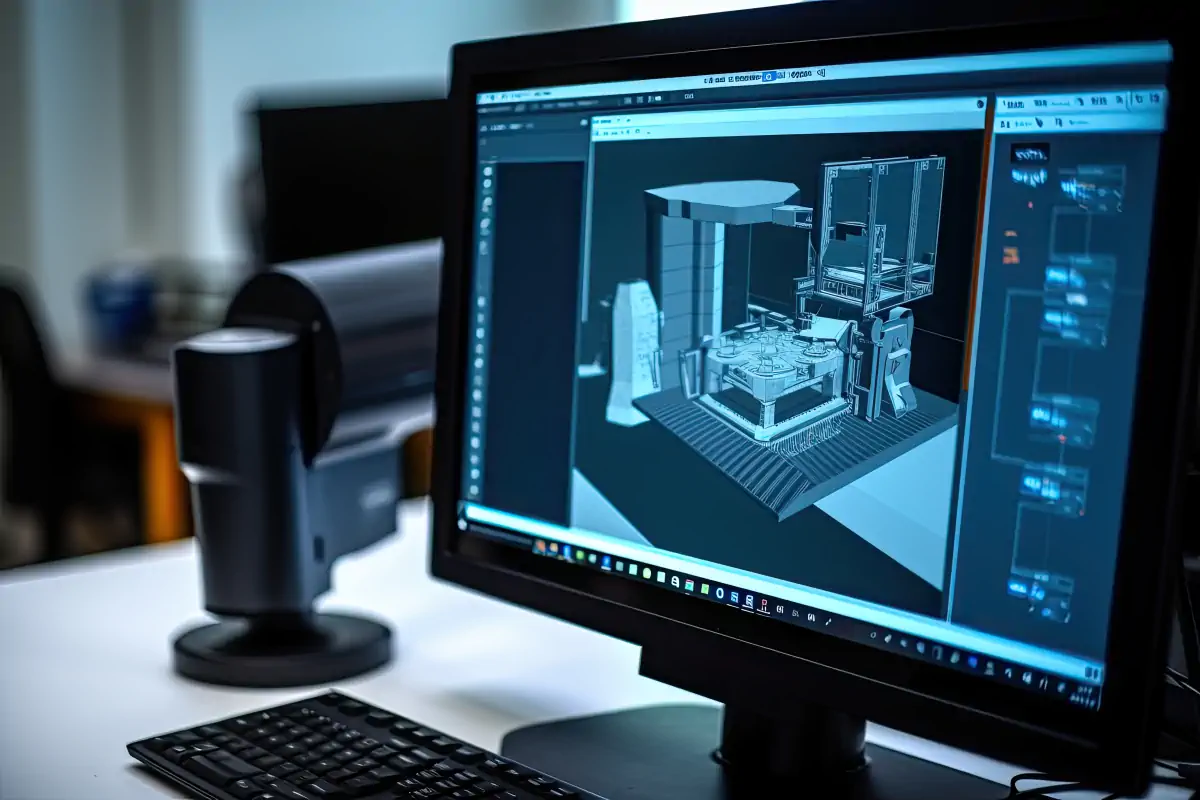
The first stage involves developing a geometric model of the tank or process vessel.
The model typically includes the shell, vessel heads, nozzles, supports, reinforcement and other structurally significant features.
Depending on the objectives of the analysis, certain geometric details may be simplified to improve computational efficiency without compromising the representation of critical structural behaviour.
Defining Materials, Loads and Boundary Conditions
The next stage involves assigning appropriate material properties and defining the intended operating conditions.
For stainless steel vessels, engineers must consider the relevant material grade, such as AISI 304 or AISI 316L, and its mechanical properties at the specified operating temperature.
The simulation may include:
- Design and test pressure.
- Vessel self-weight.
- Hydrostatic loads from the contained medium.
- External forces and moments.
- Thermal loading.
- Support constraints and imposed displacements.
The assumptions used to represent supports and other boundary conditions are particularly important, as unrealistic constraints can significantly distort calculated stresses.
Generating the Finite Element Mesh
The geometric model is divided into finite elements to create the computational mesh.
Mesh quality and element selection influence the accuracy of the results, particularly near geometric discontinuities and regions with high stress gradients.
Engineers should also assess mesh convergence to establish whether the calculated response is sufficiently independent of mesh refinement.
Evaluating Results and Optimising the Design
Once the simulation has been completed, engineers review stress distributions, displacements, strains and other relevant structural responses.
Where necessary, the design may be modified by increasing local thickness, changing component geometry or adding reinforcement.
The results must be assessed using suitable engineering criteria and the requirements of the applicable design code.
A local peak stress does not automatically indicate structural failure, particularly where numerical singularities or localised stress concentrations are involved.
What Can FEA Simulations Reveal?
Stress and Strain Distribution
One of the primary applications of FEA is evaluating how stresses are distributed throughout a structure.
For ductile metallic materials, equivalent von Mises stress is frequently used in structural assessment, although additional criteria may be required depending on the loading conditions and applicable design standard.
Finite element simulations help identify areas that require closer examination and enable engineers to assess the influence of design changes.
Pressure Vessel Strength
For pressure vessels, FEA can support structural assessment under internal and external pressure.
Special attention may be required at nozzle intersections, shell connections and other areas where geometric discontinuities influence local stresses.
The results can be used as part of a broader design verification process conducted in accordance with the relevant engineering standard.
Thermal Stress and Deformation
Process vessels frequently operate under elevated or changing temperatures.
Heating and cooling cause thermal expansion, which may generate stresses where movement is restricted or temperature gradients develop.
FEA can help evaluate these effects, particularly in vessels incorporating heating jackets, cooling systems or thermally constrained components.
Buckling and Fatigue
Vessels subjected to external pressure or vacuum conditions may be vulnerable to structural instability.
Depending on the design, buckling assessment may require nonlinear analysis that accounts for imperfections and other relevant effects.
Where equipment is exposed to repeated pressure, temperature or mechanical loading cycles, fatigue analysis may also be necessary to assess long-term structural performance.
Applications of FEA in Process Equipment Design
Finite element analysis is used not only for conventional storage vessels but also for more complex processing equipment.
Pressure Vessels and Reactors
In pressure vessel engineering, FEA supports the assessment of structural behaviour under pressure, temperature and external mechanical loads.
It can be particularly useful for vessels with non-standard geometries, multiple nozzles, complex supports or demanding operating conditions.
Industrial Mixers and Agitators
For industrial mixers and agitators, structural analysis can be used to assess vessel supports, drive mounting arrangements and other load-bearing components.
Relevant loads may include torque, rotating equipment forces, vibration and the mechanical effects associated with mixing operations.
Depending on the equipment, more detailed dynamic or fatigue assessments may be required.
Bioreactors and Fermentation Vessels
FEA can also support the engineering of bioreactors and fermentation vessels used in pharmaceutical, biotechnology and food processing applications.
These systems may be subjected to combined pressure, thermal and mechanical loads.
Structural analysis can help evaluate vessel heads, shell thickness, support arrangements and critical connection points.
For additional information about specialist vessel engineering, read our article Custom-Engineered Fermentation Tanks – Advanced Bioreactors Built to Order by GMM INOX.
Finite Element Analysis and Pressure Vessel Design Standards
When designing pressure equipment, FEA must be applied within the requirements of the relevant legislation and engineering standards.
Depending on the intended market, vessel classification and project specification, relevant documents may include:
- EN 13445: European standard covering unfired pressure vessels.
- Pressure Equipment Directive 2014/68/EU (PED): Establishes essential safety requirements for pressure equipment within its scope when placed on the EU market.
- ASME Boiler and Pressure Vessel Code, Section VIII: Used for pressure vessel design and construction where the applicable project requirements call for ASME compliance.
EN 13445-3 includes provisions for structural verification using Design by Analysis approaches.
These enable engineers to assess particular loading conditions through appropriately defined analytical or numerical methods.
An FEA simulation alone does not demonstrate compliance with EN 13445, the PED or the ASME Boiler and Pressure Vessel Code.
The analysis must use appropriate design criteria, justified assumptions and suitable verification procedures. The finished equipment must also meet all other applicable manufacturing, inspection, testing and documentation requirements.
What Are the Benefits of Finite Element Analysis?
Using FEA during the engineering stage supports more informed decisions about structural design and material selection.
The principal benefits include:
- Improved structural safety: Identifying critical regions and assessing their response to operating loads.
- Material optimisation: Evaluating wall thicknesses, reinforcement and component geometry to avoid unnecessary material use.
- Reduced manufacturing modifications: Detecting potential structural issues before fabrication begins.
- More detailed load assessment: Investigating complex combinations of pressure, temperature and mechanical forces.
- Engineering documentation: Providing calculated evidence to support design decisions and verification.
However, simulation results are only as reliable as the underlying input data and modelling methodology.
Correct material properties, realistic boundary conditions, appropriate mesh refinement and sound engineering judgement are essential.
FEA and Structural Engineering at GMM INOX
GMM INOX specialises in the design and manufacture of stainless steel equipment for the pharmaceutical, food processing and chemical industries.
Structural calculations and finite element simulations can support the assessment of equipment behaviour under specified loading conditions before fabrication begins.
Combining 3D modelling, structural analysis and precision manufacturing allows engineers to develop solutions tailored to individual process requirements.
For industrial equipment, this integrated approach helps ensure that material selection, structural geometry and manufacturing methods are considered together.
Learn more about GMM INOX’s industrial engineering and fabrication services and its expertise in bespoke stainless steel process equipment.
Conclusion – Why FEA Matters in Modern Process Equipment Engineering
Finite Element Analysis is an important tool in the design and verification of industrial tanks, pressure vessels and process equipment.
It helps engineers evaluate structural behaviour under defined operating conditions, identify potential weaknesses and assess design solutions before manufacturing begins.
FEA is particularly useful for pressure vessels, reactors, mixers and other industrial systems subjected to complex mechanical and thermal loading.
When correctly applied, structural analysis supports the development of equipment that balances safety, durability and efficient material utilisation.
GMM INOX designs and manufactures bespoke stainless steel process equipment, combining engineering expertise with fabrication capabilities tailored to individual customer requirements.
If you are planning a new industrial vessel, reactor or processing system, explore our stainless steel process and storage tank solutions or contact the GMM INOX engineering team to discuss your project requirements.

